THE SHORT ANSWER
4 in of graded base under a house slab; 4–6 in under a driveway.
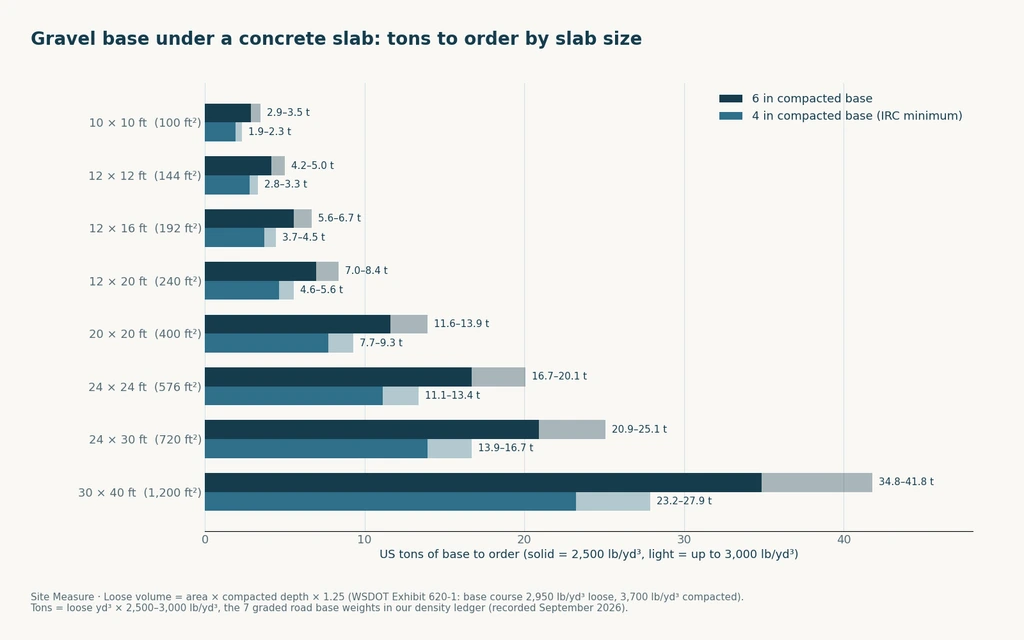
Under a house floor, the 2021 International Residential Code asks for a 4 in base of clean graded sand, gravel or crushed stone that passes a 2 in sieve (R506.2.2), with a 10-mil vapor retarder on top; a slab on well-drained Group I soil may skip the base. City standards for driveways ask for 4–6 in of compacted crushed aggregate base. A 24 × 24 ft garage slab on 4 in of compacted base needs 7.11 yd³ in place, about 8.92 yd³ or 11.1–13.4 t to order; at the $43 per ton median list price that is about $479–$575 before delivery.
The gravel under a concrete slab is called the base course: a compacted layer between the prepared soil and the concrete. It gives the slab an even, firm bed, keeps the concrete off the soil, and is what the vapor retarder is laid on. Whether you need one, and how thick, depends on what the slab is for and what soil it sits on. The depths below are quoted from the 2021 International Residential Code and two city construction standards, read on November 7, 2026; the tons use the graded base weights in our density ledger, and the costs use the list prices we recorded on September 23, 2026.
Do you need gravel under a concrete slab?
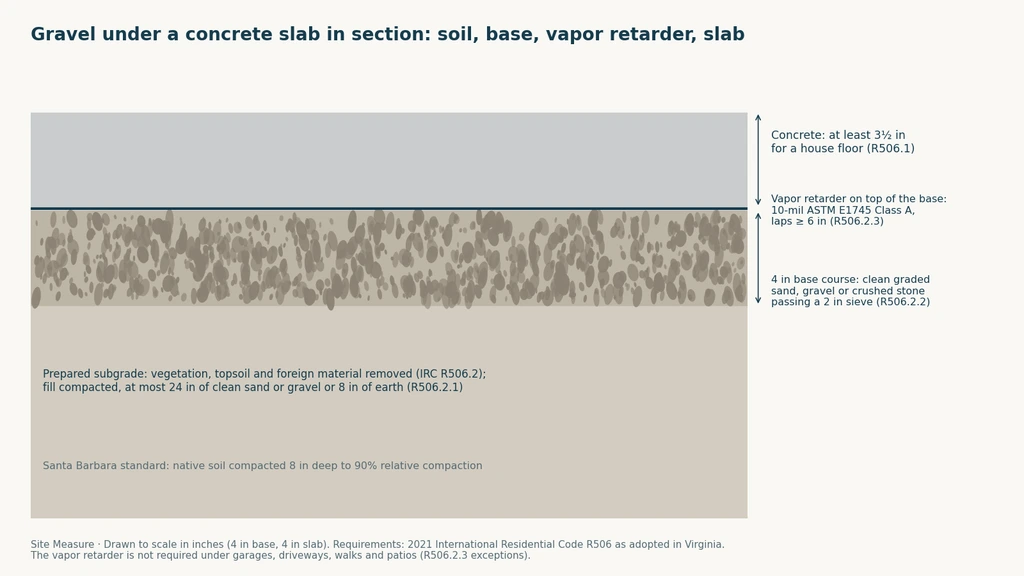
Under a house floor, usually yes. Section R506.2.2 of the 2021 IRC, quoted here as Virginia adopted it [1], says: “A four-inch-thick (102 mm) base course consisting of clean graded sand, gravel, or crushed stone passing a two-inch (51 mm) sieve shall be placed on the prepared subgrade when the slab is below grade.”
The same section lets the base go when the slab sits on soil that already drains: “A base course is not required when the concrete slab is installed on well drained or sand-gravel mixture soils classified as Group I according to the United Soil Classification System in accordance with Table R405.1.” Table R405.1 [3] sorts soils into four groups by drainage:
| Group | Unified Soil Classification symbols | Drainage | Base course under a slab |
|---|---|---|---|
| I | GW, GP, SW, SP, GM, SM (gravels and sands) | Good: over 4 in per hour | Not required |
| II | GC, SC, ML, CL (clayey gravel and sand, silt, lean clay) | Medium: 2–4 in per hour | Required |
| III | CH, MH (fat clay, elastic silt) | Poor: under 2 in per hour | Required |
| IV | OL, OH, Pt (organic soils, peat) | Poor to unsatisfactory | Required |
Driveways, patios and sidewalks are not house floors, so R506 does not set their base. The city or county that permits the driveway usually does, and the two standards in the next section both require a crushed aggregate base.
How deep the gravel base should be
No specification we found asks for less than 4 in. Santa Barbara asks for 6 in under everything except sidewalks, and both cities want crushed aggregate compacted in place, not loose stone tipped and raked flat.
| Source | Applies to | Base under the concrete | Concrete |
|---|---|---|---|
| 2021 IRC R506.1–R506.2.2 [1] | House floor slab below grade | 4 in of clean graded sand, gravel or crushed stone passing a 2 in sieve | At least 3½ in |
| Santa Barbara, CA [6] | Sidewalk | At least 4 in crushed aggregate base at 95% relative compaction; 2 in of sand at the City Engineer’s discretion | Not stated in the note |
| Santa Barbara, CA [6] | All other concrete improvements | 6 in crushed aggregate base at 95% relative compaction, on native soil compacted 8 in deep to 90% | Not stated in the note |
| Rochester Hills, MI [7] | Residential driveway approach | 4 in of 21AA aggregate base (crushed limestone or crushed concrete) | 6 in, 3,500 psi |
| Rochester Hills, MI [7] | Commercial driveway approach | 4 in of 21AA aggregate base | 8 in, 3,500 psi |
A thicker base does not stand in for the ground work. R506.2 [1] first requires that “all vegetation, top soil and foreign material” be removed from the slab area, and R506.2.1 limits fill under a slab to 24 in of clean sand or gravel or 8 in of earth unless the building official approves more.
Which gravel goes under a concrete slab
The code’s only limits are “clean graded” material and the 2 in sieve. In practice two kinds of crushed stone are sold for the job, and they behave differently:
| Graded base: crusher run, road base, 21AA, CA6, Class 2 | Clean ¾ in crushed stone or #57 | |
|---|---|---|
| What is in it | Every size from the top stone down to fines | Stone of one size range, fines washed or screened out |
| How it compacts | Packs into a dense, flat layer; the city standards above set 95% relative compaction | Does not bind into a hard layer; the top stays loose |
| Water | Drains slowly through the fines | Drains freely |
| Weight, loose | 2,500–3,000 lb/yd³ (7 ledger entries) | 2,400–2,800 lb/yd³ (4 ledger entries) |
| List price | $15–$57 per ton, median $43 (8 prices) | $21.50–$69 per ton, median $42.75 (6 prices) |
Both city standards name graded bases: Rochester Hills’ 21AA (Michigan’s dense-graded aggregate) and Santa Barbara’s crushed aggregate base. A graded base is the one that compacts to the firm, flat surface the specs describe; yards sell it as road base or crusher run. Clean stone such as #57 drains freely and meets the IRC wording, but it does not lock into a hard surface; it is the usual choice under a gravel shed pad or around a French drain, where water has to pass through.
The names change by state. In our price and weight ledgers the same kind of graded material is sold as 21AA in Michigan, CA6 in Illinois, Class 2 base in California, Class 5 in Minnesota, Class 6 in Colorado and ABC in North Carolina and Arizona.
Vapor retarder: on top of the gravel, under the concrete
R506.2.3 of the 2021 IRC [1]: “A minimum 10-mil (0.010 inch; 0.254 mm) vapor retarder conforming to ASTM E1745 Class A requirements with joints lapped not less than 6 inches (152 mm) shall be placed between the concrete floor slab and the base course or the prepared subgrade where a base course does not exist.” From the ground up the order is compacted soil, gravel base, vapor retarder, concrete.
The code lists where the retarder is not required:
- Garages, utility buildings and other unheated accessory structures.
- Unheated storage rooms of less than 70 ft², and carports.
- Driveways, walks, patios and other flatwork not likely to be enclosed and heated at a later date.
- Where the building official approves it, based on local site conditions.
Not every state is on the 2021 wording. Oklahoma’s rules [5] for its 2018 IRC adoption still accept “a 6 mil (0.006 inch; 152 micrometers) polyethylene sheeting” or other industry-accepted retarders installed to the maker’s instructions, so ask your building department which edition it enforces before you buy film.
How much gravel to order for a slab
The volume in place is the slab area times the compacted depth. A compacted base holds more stone than its finished volume suggests: Washington State DOT’s Design Manual [8] lists crushed surfacing base course at 2,950 lb/yd³ loose and 3,700 lb/yd³ compacted, so each compacted cubic yard takes about 1.25 loose cubic yards. The table orders that loose volume and weighs it at 2,500–3,000 lb/yd³, the 7 graded base weights in our density ledger.
| Slab | Typical use | 4 in compacted: yd³ in place | 4 in: yd³ to order | 4 in: tons | 6 in compacted: yd³ to order | 6 in: tons |
|---|---|---|---|---|---|---|
| 10 × 10 ft (100 ft²) | Small shed or pad | 1.23 | 1.55 | 1.9–2.3 t | 2.32 | 2.9–3.5 t |
| 12 × 12 ft (144 ft²) | Shed or hot-tub pad | 1.78 | 2.23 | 2.8–3.3 t | 3.34 | 4.2–5.0 t |
| 12 × 16 ft (192 ft²) | Patio | 2.37 | 2.97 | 3.7–4.5 t | 4.46 | 5.6–6.7 t |
| 12 × 20 ft (240 ft²) | Single-car carport | 2.96 | 3.72 | 4.6–5.6 t | 5.57 | 7.0–8.4 t |
| 20 × 20 ft (400 ft²) | Two-car garage, small | 4.94 | 6.19 | 7.7–9.3 t | 9.29 | 11.6–13.9 t |
| 24 × 24 ft (576 ft²) | Two-car garage | 7.11 | 8.92 | 11.1–13.4 t | 13.38 | 16.7–20.1 t |
| 24 × 30 ft (720 ft²) | Two-car garage with shop | 8.89 | 11.15 | 13.9–16.7 t | 16.72 | 20.9–25.1 t |
| 30 × 40 ft (1,200 ft²) | Detached shop | 14.81 | 18.58 | 23.2–27.9 t | 27.87 | 34.8–41.8 t |
Small slabs fall under most yards’ minimum loads: a 10 × 10 ft pad at 4 in is about 1.9–2.3 t, so expect a short-load fee or pick it up. A 30 × 40 ft shop at 6 in needs 34.8–41.8 t, two or more loads at the truck sizes in our dump truck load guide. For a slab not in the table, the road base calculator does the same arithmetic with the compaction allowance built in.
What the gravel base costs
We recorded 11 list prices for crusher run and road base on September 23, 2026, one from each of 11 supplier lists. By the ton they run $15 to $57, median $43; by the yard $54.22 to $99.99. Delivery is extra or quoted separately on every list.
| Supplier | Location | Product | Price | Terms |
|---|---|---|---|---|
| Main's Landscape Supply | Southfield, MI | Limestone with fines 21AA | $65.99 per yd³ | Delivery extra |
| Young's Sand & Gravel | Loudonville, OH | #310 Crusher Run | $15 per ton | Pickup; delivery quoted |
| Bracht Bros | Forest Lake, MN | Class 5 Road Gravel | $28.50 per ton | Pickup; plus county tax |
| Piedmont Landscape Materials | Concord, NC | ABC Stone | $56 per ton | Delivery from $50 |
| BOSS Boone One Stop Supply | Wake Forest, NC | Crusher Run (ABC) | $54.22 per yd³ | Delivery at checkout |
| Down To Earth Materials | Gray, TN | Crusher Run | $57 per ton | Delivery $10 per mile |
| Mulch Pros Landscape Supply | Cumming, GA | Crush & Run | $54.95 per ton | Free pickup; delivery per mile |
| Texas Garden Materials | Houston, TX | Crushed Limestone 1.5 inch minus | $99.99 per yd³ | Pickup; delivery at checkout |
| Bedrock Landscaping Materials | Denver, CO | Granite Road Base (Class 6) | $45 per ton | Delivery extra (flat fee by distance) |
| Ainsworth Rock Sales | Denver, CO | Road Base Class 6 | $39.95 per ton | Delivery and tax not stated |
| AZ Rock Express | Apache Junction, AZ | ABC Road-base | $41 per ton | Delivery by zone and tonnage |
| Slab | 4 in at the median | 4 in, lowest to highest list | 6 in at the median | 6 in, lowest to highest list |
|---|---|---|---|---|
| 10 × 10 ft | $83–$100 | $29–$132 | $125–$150 | $44–$199 |
| 12 × 12 ft | $120–$144 | $42–$191 | $180–$216 | $63–$286 |
| 12 × 16 ft | $160–$192 | $56–$254 | $240–$288 | $84–$381 |
| 12 × 20 ft | $200–$240 | $70–$318 | $300–$360 | $105–$477 |
| 20 × 20 ft | $333–$399 | $116–$530 | $499–$599 | $174–$794 |
| 24 × 24 ft | $479–$575 | $167–$763 | $719–$863 | $251–$1,144 |
| 24 × 30 ft | $599–$719 | $209–$953 | $899–$1,079 | $314–$1,430 |
| 30 × 40 ft | $999–$1,198 | $348–$1,589 | $1,498–$1,798 | $523–$2,383 |
Delivery is priced separately; see gravel prices for the delivery fees each list publishes, and convert between tons and yards with the cubic yards to tons converter. Before you order, ask the yard:
- For its graded base by the local name (21AA, CA6, Class 2, crusher run or road base), and say it is going under concrete.
- Whether the price is per ton or per cubic yard, and whether it is loaded at the pit or delivered.
- What its minimum load is and what it charges for a load below it.
Preparing the ground and compacting the base
- Strip the slab area: R506.2 [1] requires removing all vegetation, topsoil and foreign material.
- Compact the soil and any fill. R506.2.1 says fill “shall be compacted to assure uniform support of the slab”; Santa Barbara’s standard [6] compacts native soil 8 in deep to 90% relative compaction.
- Spread and compact the base. Santa Barbara sets 95% relative compaction; Virginia DOT [9] and Caltrans [10] allow at most 6 in compacted per layer on road work, so a 4 or 6 in slab base goes down in one lift and a thicker one in two.
- Lay the vapor retarder on the finished base where R506.2.3 requires one, lapping joints at least 6 in, and place the concrete on it.
How these figures were worked out
- Compacted yd³ = slab length × width (ft) × compacted depth (in) ÷ 12 ÷ 27.
- Loose yd³ to order = compacted yd³ × 3,700 ÷ 2,950 = × 1.254, the WSDOT Exhibit 620-1 loose and compacted weights of crushed surfacing base course.
- Tons = loose yd³ × 2,500 or 3,000 lb ÷ 2,000: the lightest and heaviest of the 7 graded base weights in our density ledger.
- Cost = tons × the per-ton list price (median $43, lowest $15, highest $57); delivery and tax excluded. No waste allowance.
Questions
Can you pour concrete directly on dirt?
For a house floor, the 2021 IRC allows it only on well-drained Group I soils (gravels and sands, USCS GW, GP, SW, SP, GM, SM); clay and silt soils need the 4 in base. The soil must still be stripped of vegetation and topsoil and compacted, and a city may require a base under driveways and walks regardless.
Is sand or gravel better under a concrete slab?
The IRC accepts clean graded sand, gravel or crushed stone for the 4 in base. City standards for driveways specify crushed aggregate base; Santa Barbara allows 2 in of sand only under sidewalks, at the City Engineer’s discretion.
Can I use #57 stone under a concrete slab?
Yes, the IRC wording covers crushed stone that passes a 2 in sieve, and #57 does. It drains freely but does not compact into a hard, flat surface the way crusher run or road base does, which is why the city driveway standards quoted here name graded bases.
How thick should a concrete slab be?
The 2021 IRC sets a minimum of 3½ in for a house floor slab (R506.1). Driveway standards are thicker: Rochester Hills, Michigan, asks for 6 in on residential driveway approaches and 8 in on commercial ones.
Sources
- Virginia Residential Code 2021 (2021 IRC), Section R506 Concrete Floors (On Ground), via UpCodes
R506.1 3½ in slab; R506.2–R506.2.1 site preparation and fill; R506.2.2 4 in base and Group I exception; R506.2.3 10-mil retarder and exceptions. Read November 7, 2026.
- Colorado DFPC Residential Code 2021, Section R506, via UpCodes
The same R506.2.2 and R506.2.3 wording in a second 2021 IRC adoption. Read November 7, 2026.
- Virginia Residential Code 2021, Table R405.1 Properties of Soils, via UpCodes
Soil groups I–IV, their USCS symbols, drainage and percolation rates. Read November 7, 2026.
- International Code Council: 2021 International Residential Code, Chapter 5 Floors
The model code the state adoptions above are based on. Read November 7, 2026.
- Oklahoma Administrative Code 748:20-6-10, IRC 2018 Chapter 5 Floors, via Cornell LII
Oklahoma’s 2018 IRC R506.2.3 as amended: 6 mil polyethylene or other industry-accepted retarders. Read November 7, 2026.
- City of Santa Barbara: Construction Standard Details, Section H Hardscape
General Concrete Note 4: 6 in base under concrete improvements, 4 in under sidewalk, 95% and 90% relative compaction. Read November 7, 2026.
- City of Rochester Hills: Engineering Design Standards, Chapter 8 Driveway Approaches
6 in (residential) and 8 in (commercial) 3,500 psi concrete over 4 in 21AA aggregate base. Read November 7, 2026.
- Washington State DOT Design Manual M 22-01, Chapter 620, Exhibit 620-1
Crushed surfacing base course 2,950 lb/yd³ loose and 3,700 lb/yd³ compacted. Read November 7, 2026.
- Virginia DOT Road and Bridge Specifications 2020, Section 309.05
Not more than 6 in compacted per layer. Read November 7, 2026.
- Caltrans Standard Specifications, Section 26 Aggregate Bases (MnDOT-hosted copy)
Layers no thicker than 0.50 ft compacted; 95% relative compaction. Read November 7, 2026.
Every figure on this page links to its source; recorded dates are shown with the figures or in the gravel weight and price ledgers, and the arithmetic is covered by automated tests. How we source and calculate · Report an error