THE SHORT ANSWER
Washed #57 stone, 2 in under the pipe and 6 in over it.
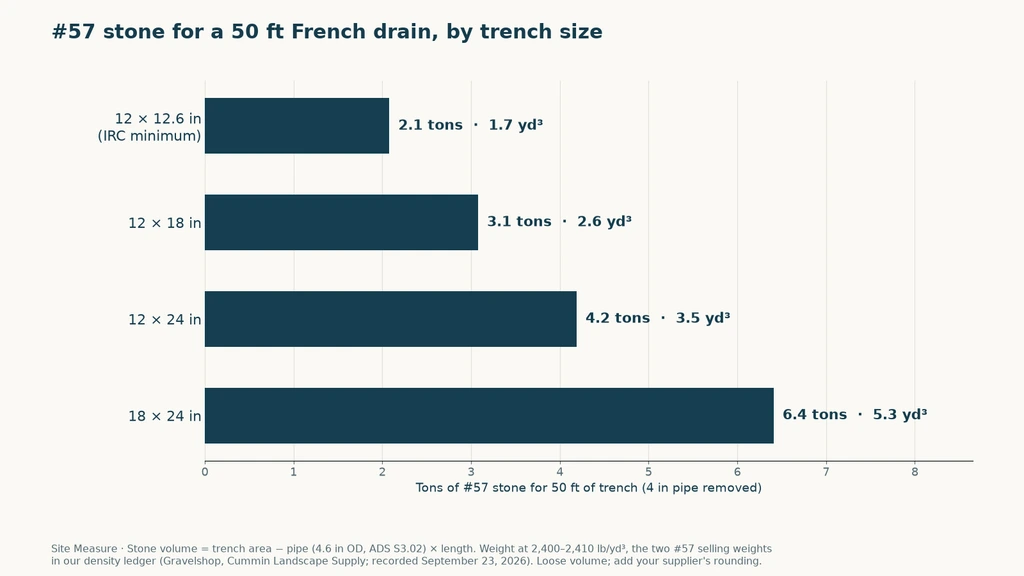
For the usual yard trench, a foot wide with 18 in of stone around a 4 in pipe, order about 0.6 tons for every 10 ft of your run. A 50 ft run takes about 3.1 tons, which cost $66 to $213 at the list prices we recorded, before delivery.
A French drain is a trench of clean stone, usually around a perforated pipe, that catches water and carries it somewhere lower. The stone has two jobs: let water in fast, and stay bigger than the slots in the pipe so it never washes inside. Below is which stone to ask for, how deep you need to dig, how much to order and how to lay it. The sizes and depths come from the building code and state highway specifications, read on November 7, 2026; the weights and prices come from our ledgers, recorded September 23, 2026.
Which stone to use for a French drain
Ask the yard for washed #57 stone. It is crushed stone from about walnut size down to pea size with the dust rinsed out, and it is what the engineers specify: Texas DOT [2] makes it the default filter stone around its pipe underdrains, and Maryland’s stormwater guide [6] calls it the most widely used aggregate in stormwater construction. Your yard may call it #57, 57 stone, ¾ in clean or, in Pennsylvania, 2B; the #57 stone calculator covers the names and the weights.
Two things you will be offered and should turn down. Pea gravel looks right but is often too small: its grains run down past the width of the slots in a drain pipe, so they wash in (the sizes are in the specifications below). Crusher run and anything “with fines” packs hard and drains slowly, which is the opposite of what a drain needs. “Washed” matters for the same reason: the dust left on unwashed stone is what clogs the trench.
How deep and how wide to dig
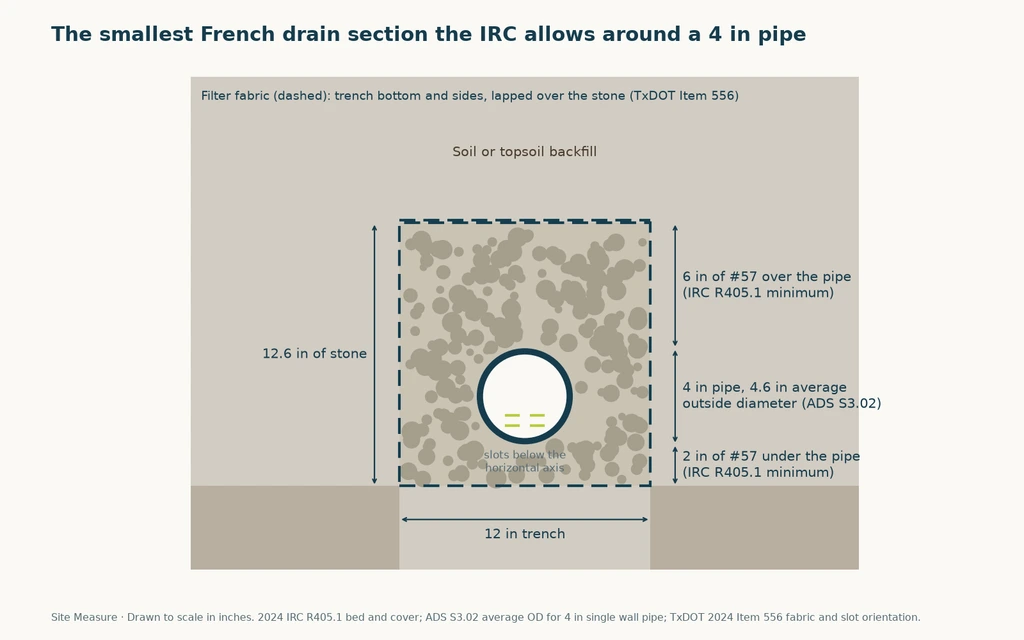
The building code sets the floor: IRC R405.1 [1] puts the pipe on at least 2 in of stone and covers it with at least 6 in. Allow for the pipe itself (ADS [4] publishes its outside width) and the least stone that meets the code comes to about a foot; the drawing below is to that section. Most yard trenches go deeper, a foot and a half to two feet, to hold more water and to get the pipe below the soil that stays wet; if your ground stays soggy for days after rain, dig to the deeper end. Highway underdrains put at least 12 in of stone above the bottom of the pipe (TxDOT [2]). A foot wide is enough for a standard pipe with stone either side; go wider where your drain has to take a lot of water.
Next to a house, the code also asks the drain to reach a foot beyond the outside edge of the footing and above the top of it, and to discharge by gravity or a pump into an approved outlet. Find the lower point you can actually drain to before you dig anything else.
How much #57 stone to order
The table gives loose stone with the pipe already subtracted, at the two #57 weights in our ledger, from Gravelshop and Cummin Landscape Supply; the two are so close that the tons barely differ. Yards sell by the ton or the yard in half or whole units, so round up to the increment your yard sells in.
| Trench (width × stone depth) | Per 10 ft | Per 50 ft | Per 100 ft |
|---|---|---|---|
| 12 × 12.6 in (IRC minimum) | 0.42 t · 0.35 yd³ | 2.09 t · 1.73 yd³ | 4.17 t · 3.46 yd³ |
| 12 × 18 in (the usual yard trench) | 0.62 t · 0.51 yd³ | 3.09 t · 2.56 yd³ | 6.18 t · 5.13 yd³ |
| 12 × 24 in | 0.84 t · 0.70 yd³ | 4.21 t · 3.49 yd³ | 8.41 t · 6.98 yd³ |
| 18 × 24 in | 1.29 t · 1.07 yd³ | 6.44 t · 5.34 yd³ | 12.82–12.87 t · 10.68 yd³ |
If your trench is not in the table, put its length, width and stone depth into the #57 stone calculator. It does not subtract the pipe, so its answer runs a little high, which is the safe side to order on.
What the stone costs
The #57 list prices we recorded run from $21.50 to $69 a ton, and every list adds delivery. For the trench in the short answer you are looking at $66 to $213 of stone. On an order this small, your delivery charge can cost more than the stone; the dump truck load guide shows how the price per ton falls as the order grows, and why a few tons is a short load.
| Supplier | Location | Product | Price | Terms |
|---|---|---|---|---|
| Young's Sand & Gravel | Loudonville, OH | #57 Gravel (washed) | $21.50 per ton | Pickup; delivery quoted |
| Young's Sand & Gravel | Loudonville, OH | #57 Limestone | $36 per ton | Pickup; delivery quoted |
| Piedmont Landscape Materials | Concord, NC | 57 Stone | $69 per ton | Delivery from $50 |
| BOSS Boone One Stop Supply | Wake Forest, NC | Clean (Washed) Stone #57 | $59.77 per yd³ | Delivery at checkout |
| Mulch Pros Landscape Supply | Cumming, GA | #57 Stone | $58.95 per ton | Free pickup; delivery per mile |
Laying the fabric, the pipe and the stone
The order below is Texas DOT’s for a pipe underdrain (Item 556 [2]), with the code’s bed and cover depths. It is the same job at the scale of your yard.
- Dig to a fall. The trench must run downhill to its outlet the whole way; check the bottom with a level as you go.
- Line it with fabric. Lay non-woven filter fabric over the bottom and up both sides, with enough spare at the top to fold over the stone later; for your trench that means at least 60 in wide for the 12 × 18 in trench, before the overlap your fabric maker specifies.
- Bed the pipe. Spread 2 in of stone, then set the pipe on it, centred, with the holes facing down.
- Cover it. Fill with stone to at least 6 in over the top of the pipe, or to your chosen depth.
- Close the fabric. Fold the spare fabric over the top of the stone so soil cannot work down into it, then top with stone, turf or soil as you like.
The specifications behind the answer
You do not need this section to build the drain; it is here so you can check the answer against the documents. The code’s rule for the stone is that it be at least “one sieve size larger than the tile joint opening or perforation” (R405.1 [1]). A typical pipe has slots up to 0.12 in wide (ADS [5]). #57 passes that test; the stone sold as pea gravel, often size No. 8, does not.
| Sieve | Passing |
|---|---|
| 1½ in | 100% |
| 1 in | 95–100% |
| ½ in | 25–60% |
| No. 4 (4.75 mm, about 3/16 in) | 0–10% |
| No. 8 (2.36 mm) | 0–5% |
Size No. 8 runs from ⅜ in down to the No. 8 sieve, with up to a third of it passing No. 4: its smallest grains are narrower than the slot. #57 ends at the No. 4 sieve, more than one and a half times the slot width. The specifications care about size and cleanliness, not shape: the code accepts washed gravel or crushed rock, and TxDOT’s filter material may be “sand, gravel, crushed stone, or crushed shell” that meets the grading, with loss by decantation held to 1% of the material retained on the No. 4 sieve. That is the technical version of “washed”.
How much water the trench holds while it fills: stormwater manuals size #57 beds at 40% voids (Virginia DEQ [7], Minnesota [8]). At that porosity plus the inside of the pipe, every 10 ft of the trench in the short answer holds about 48 gallons as it fills. That is storage, not how fast the pipe carries water away.
How these figures were worked out
- Stone per foot of trench (ft³) = width × stone depth ÷ 144 − π × (4.6 ÷ 24)², the pipe’s outside area.
- Tons = ft³ ÷ 27 × 2,400 or 2,410 lb per yd³ ÷ 2,000. Loose volume; no compaction or waste allowance.
- Cost = tons at the heavier weight × the per-ton list price (lowest $21.50, highest $69); delivery and tax excluded.
- Water held per foot (gallons) = (stone ft³ × 0.4 + π × (4 ÷ 24)²) × 7.48.
- Fabric width = 2 × trench width + 2 × stone depth, plus overlap.
Questions
Is pea gravel all right in a French drain?
Usually not, and the reason is size rather than shape. Pea gravel sold as ⅜ in is often size No. 8, whose grading runs down to the No. 8 sieve (2.36 mm): smaller than the 3 mm slots in a typical 4 in drain pipe, with up to 30% of it passing the No. 4 sieve. Those grains wash into the pipe. #57 stops at the No. 4 sieve (4.75 mm), and highway underdrain specifications such as Texas DOT’s default to it.
Which way do the holes in the pipe face?
Down. Texas DOT’s underdrain specification centres the perforated pipe in the trench with the perforations below the horizontal axis, so water rising through the stone enters from beneath and your pipe carries it off before the trench fills.
Does a French drain need a pipe at all?
Not always. The 2024 International Residential Code allows a foundation drain of gravel or crushed stone with no pipe, as long as the stone extends at least 1 ft beyond the outside edge of the footing and 6 in above its top and is covered by a filter membrane. A pipe carries water away faster; a stone-only trench stores it until your soil takes it.
Can I skip the fabric?
The specifications say no. Texas DOT lines the trench bottom and sides with filter fabric before the pipe and stone go in and laps it over the top; the code asks for an approved filter membrane over the stone or around the pipe. Without it, fines from your soil work into the stone and your trench slowly clogs.
Sources
- International Code Council: 2024 International Residential Code, R405.1 Concrete or masonry foundations
Drain tile on at least 2 in of washed gravel or crushed rock, covered by at least 6 in, stone one sieve size larger than the perforation, filter membrane, gravity or mechanical discharge; a stone drain without pipe extends 1 ft beyond the footing and 6 in above it. Read November 7, 2026.
- Texas DOT: 2024 Standard Specifications, Item 556 Pipe Underdrains
Type G (Grade 4, #57) filter material unless the plans say otherwise; filter fabric on the trench bottom and sides, lapped over the stone; pipe centred with perforations below the horizontal axis; filter material at least 12 in above the pipe bottom; loss by decantation at most 1%. Read November 7, 2026.
- Florida DOT: Section 901, Table 1, Standard Sizes of Coarse Aggregate
Gradations of sizes No. 57 (1 in to No. 4) and No. 8 (⅜ in to No. 8). Read November 7, 2026.
- ADS: S3.02 Single Wall Heavy Duty Pipe Specification
4.6 in average outside diameter of 4 in pipe. Read November 7, 2026.
- ADS: TN 1.02 Single Wall HDPE Perforation Patterns
0.120 in (3 mm) maximum slot width for 4 in pipe. Read November 7, 2026.
- Maryland Department of the Environment: Guide to Common Construction Materials and Components
No. 57 as the most widely used stormwater aggregate, including around underdrains. Read November 7, 2026.
- Virginia DEQ: Stormwater Design Specification No. 7, v2.0
Design porosity of 0.4 for No. 57 stone. Read November 7, 2026.
- Minnesota Pollution Control Agency: Minnesota Stormwater Manual, design criteria for permeable pavement
Minimum void ratio of 40 percent. Read November 7, 2026.
Every figure on this page links to its source; recorded dates are shown with the figures or in the gravel weight and price ledgers, and the arithmetic is covered by automated tests. How we source and calculate · Report an error