THE SHORT ANSWER
Clean, washed, crushed stone of one size drains best.
The stormwater manuals quoted below ask for crushed stone with the fines washed out: AASHTO No. 57 or No. 3 in Philadelphia, 1½–3 in drain rock in Western Washington and Minnesota. Pea gravel is used only as a filter layer, and crusher run, which keeps its fines, is not used where water has to pass through. A downspout drywell for 2,000 ft² of roof on medium sand takes 180 ft³ of stone (6.67 yd³, 8.0–9.3 t); the same roof on loam needs 380 ft of trench instead.
Gravel drains because water runs through the gaps between the stones. Philadelphia and Minnesota both size stone beds at 40% voids, so a cubic yard of clean stone holds about 81 gallons of water while it soaks away. Fines fill those gaps, which is why every specification below asks for washed stone. The sizing comes from public stormwater manuals and the residential code, read on November 7, 2026; the tons use the clean #57 and ¾ in stone weights in our density ledger, and the costs the list prices we recorded on September 23, 2026.
Which gravel is best for drainage
| Stone | What it is | For drainage |
|---|---|---|
| #57 stone | Crushed stone of one size band, about 1 in down to No. 4 (3/16 in) | Named by Philadelphia Water [3] for drainage-well storage beds and called the most widely used stormwater aggregate by Maryland [6] |
| 1½–3 in drain rock, No. 3 | Larger crushed stone, washed (Minnesota asks for double-washed) | Western Washington [1] downspout drywells and trenches; Minnesota [4] infiltration trenches at a 0.40 void ratio |
| Pea gravel | Small rounded stone | Philadelphia allows it only as a filter layer at the bottom of a drainage well, in place of geotextile |
| Crusher run, road base | Every size down to dust; Virginia DOT [7] defines it by its fines | Not allowed by any drainage specification quoted here: the fines pack the gaps shut, which makes it a good base and a poor drain |
The weight difference between them is small next to the volume a job takes: the clean stone rows in our ledger run 2,400–2,800 lb per cubic yard (4 entries). The ledger has no published weight for 1½–3 in drain rock, so the tons on this page use the #57 and ¾ in figures; ask your yard for its own.
Gravel for each drainage job
| Job | Stone | How much, how deep |
|---|---|---|
| Foundation drain (IRC R405.1) [5] | Gravel or crushed stone; washed around the pipe | “not less than 1 foot (305 mm) beyond the outside edge of the footing and 6 inches (152 mm) above the top of the footing,” under a filter membrane; pipe on 2 in and under 6 in of stone |
| French drain | #57 or similar clean stone | Trench sizes and tons per 10 ft in the French drain guide |
| Downspout drywell | 1½–3 in clean drain rock | 60 or 90 ft³ per 1,000 ft² of roof, at least 4 ft across, under 1 ft of topsoil; coarse or medium sand only |
| Downspout trench | 1½–3 in clean drain rock | 2 ft wide, 18 in of rock, 20–190 ft per 1,000 ft² of roof by soil |
| Drainage well storage bed [3] | Clean-washed crushed No. 57 or No. 3 | At least 6 in of bedding stone; 0.40 porosity for storage |
How much gravel a downspout drywell takes
A drywell is a pit of stone that takes a downspout and lets the water soak in. The Washougal handout [1], drawn from the Stormwater Management Manual for Western Washington, sizes the stone by roof area: 60 ft³ per 1,000 ft² on coarse sand and cobbles, 90 ft³ on medium sand. On finer soils it does not allow a drywell at all; use a trench. Measure the roof itself, overhangs included, not the floor area.
| Roof area | Coarse sands and cobbles: ft³ (yd³) | Medium sand: ft³ (yd³) | Coarse sands and cobbles: tons | Medium sand: tons | Medium sand: water held |
|---|---|---|---|---|---|
| 1,000 ft² | 60 (2.22) | 90 (3.33) | 2.7–3.1 t | 4.0–4.7 t | 269 gal |
| 1,500 ft² | 90 (3.33) | 135 (5.00) | 4.0–4.7 t | 6.0–7.0 t | 404 gal |
| 2,000 ft² | 120 (4.44) | 180 (6.67) | 5.3–6.2 t | 8.0–9.3 t | 539 gal |
| 2,500 ft² | 150 (5.56) | 225 (8.33) | 6.7–7.8 t | 10.0–11.7 t | 673 gal |
| 3,000 ft² | 180 (6.67) | 270 (10.00) | 8.0–9.3 t | 12.0–14.0 t | 808 gal |
The handout turns the volume into a width with its own formula, diameter = 2√volume ÷ (1.77√height), which is the volume of a cylinder solved for its width. For 2,000 ft² on medium sand (180 ft³), a drywell 4 ft tall is 7.6 ft across. It never goes below 4 ft wide, its bottom stays at least 1 ft above the seasonal high groundwater, and 1 ft of topsoil covers it.
How much gravel a downspout trench takes
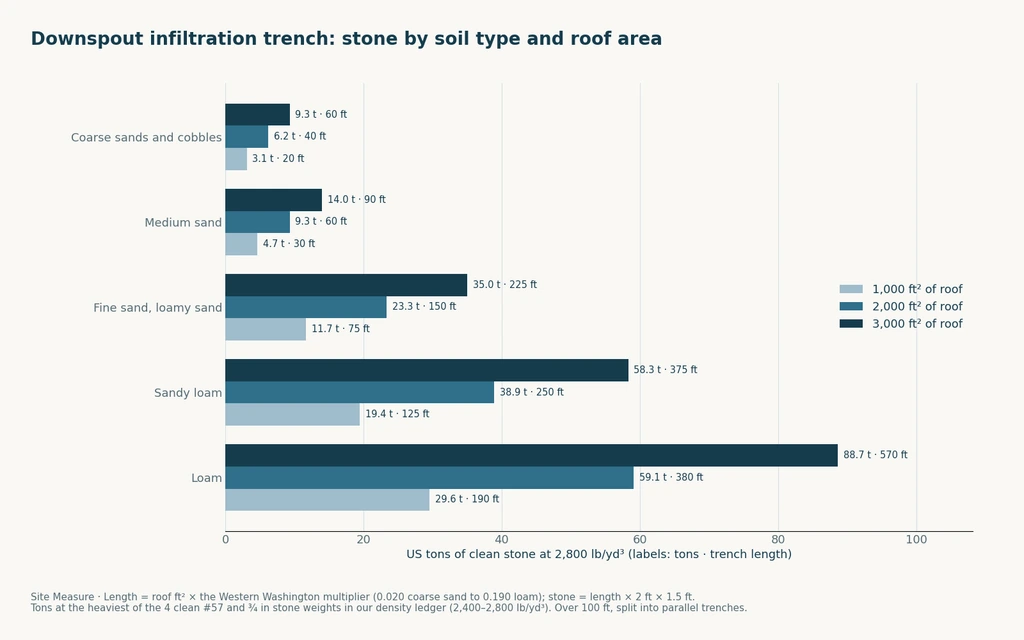
On soils that drain more slowly the water needs more ground, so the stone goes into a long, shallow trench. The handout fixes the section at 2 ft wide and 18 in of rock with a 6 in perforated pipe, so every foot of trench takes 3 ft³ of stone. The length comes from the roof area and the soil; Clark County’s manual [2] prints the same lengths per 1,000 ft². No single trench runs past 100 ft: longer runs split into parallel trenches with centerlines at least 6 ft apart.
| Roof area | Coarse sands and cobbles | Medium sand | Fine sand, loamy sand | Sandy loam | Loam |
|---|---|---|---|---|---|
| 1,000 ft² | 20 ft | 30 ft | 75 ft | 125 ft (2 trenches) | 190 ft (2 trenches) |
| 1,500 ft² | 30 ft | 45 ft | 113 ft (2 trenches) | 188 ft (2 trenches) | 285 ft (3 trenches) |
| 2,000 ft² | 40 ft | 60 ft | 150 ft (2 trenches) | 250 ft (3 trenches) | 380 ft (4 trenches) |
| 2,500 ft² | 50 ft | 75 ft | 188 ft (2 trenches) | 313 ft (4 trenches) | 475 ft (5 trenches) |
| 3,000 ft² | 60 ft | 90 ft | 225 ft (3 trenches) | 375 ft (4 trenches) | 570 ft (6 trenches) |
| Soil | Length | Stone, ft³ | Stone, yd³ | Tons |
|---|---|---|---|---|
| Coarse sands and cobbles | 40 ft | 120 | 4.44 | 5.3–6.2 t |
| Medium sand | 60 ft | 180 | 6.67 | 8.0–9.3 t |
| Fine sand, loamy sand | 150 ft | 450 | 16.67 | 20.0–23.3 t |
| Sandy loam | 250 ft | 750 | 27.78 | 33.3–38.9 t |
| Loam | 380 ft | 1,140 | 42.22 | 50.7–59.1 t |
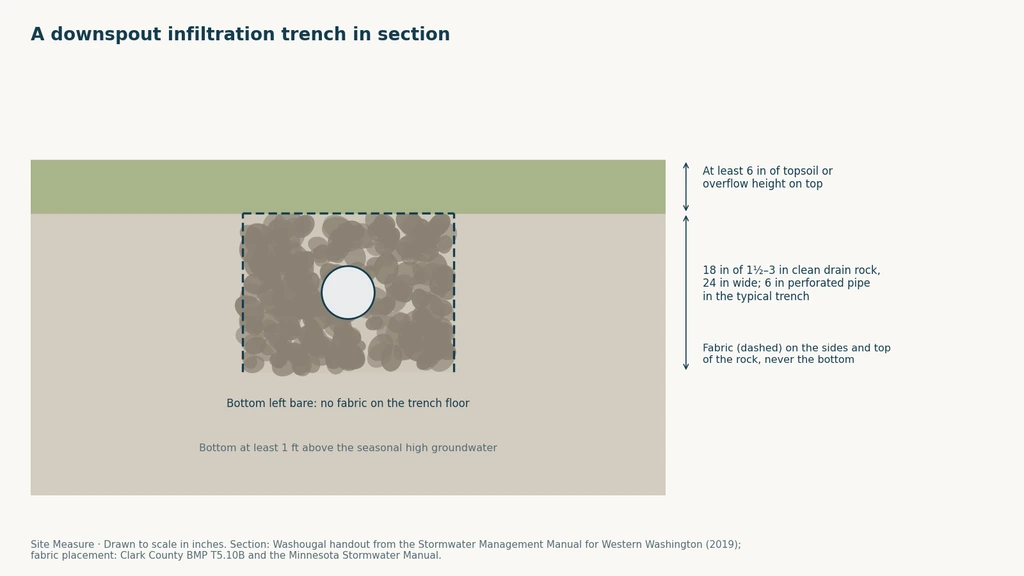
On medium sand the trench and the drywell take the same 180 ft³; on loam the trench needs 1,140 ft³ (50.7–59.1 t), which is why soil type matters more than roof size. Both manuals put filter fabric on the top and sides of the rock and none on the bottom, so the trench floor stays open to the soil.
Where not to put a drywell or drainage trench
| Limit | Washougal, WA (homeowner handout) [1] | Philadelphia Water (drainage wells) [3] |
|---|---|---|
| Building foundation | At least 15 ft | At least 10 ft from the building or retaining wall |
| Property line | Not stated | At least 10 ft |
| Groundwater | Bottom 1 ft above the seasonal high | Bottom 2 ft above groundwater, bedrock or poor soil |
| Septic system and wells | 10 ft from septic; 100 ft from drinking-water wells | Not stated |
| Slopes | Not on slopes over 15%, or within 200 ft of one over 40% | Not stated |
Washougal’s handout also routes the job to a licensed engineer if the system goes under pavement, into fill, or takes more than 4,999 ft² of roof. Rules differ by city, so check yours before you dig, and call 811 to have utilities marked first.
What drainage gravel costs
We recorded 6 per-ton list prices for #57 and ¾ in clean crushed stone on September 23, 2026: $21.50 to $69, median $42.75, before delivery. At the median, the 2,000 ft² drywell on medium sand costs about $342–$399 in stone, and the loam trench for the same roof about $2,166–$2,527. The gravel prices page lists every row with its supplier and delivery terms, and the #57 stone calculator works out any other size.
How these figures were worked out
- Drywell stone (ft³) = roof ft² × 0.060 (coarse sand and cobbles) or 0.090 (medium sand).
- Trench length (ft) = roof ft² × 0.020, 0.030, 0.075, 0.125 or 0.190 by soil; stone = length × 2 ft × 1.5 ft; trenches = length ÷ 100, rounded up.
- yd³ = ft³ ÷ 27; tons = yd³ × 2,400 or 2,800 lb ÷ 2,000, the lightest and heaviest clean #57 and ¾ in stone weights in our ledger.
- Water held = stone ft³ × 0.4 × 7.48 gallons per ft³. Cost = tons × the per-ton median; delivery and tax excluded.
Questions
What size gravel is best for drainage?
The stormwater manuals quoted here use clean, washed, crushed stone of one size: AASHTO No. 57 (about 1 in down to No. 4) or No. 3 in Philadelphia, and 1½–3 in drain rock in Western Washington and Minnesota. What matters most is that the stone is crushed, of one size and washed of fines.
Is pea gravel good for drainage?
Pea gravel is clean and lets water through, but it is rounded and shifts underfoot. The storage beds in the manuals quoted here call for crushed stone; Philadelphia uses pea gravel only as a filter layer at the bottom of a drainage well, in place of fabric.
Can you use crusher run for drainage?
Not where water has to pass through. Crusher run keeps every size down to dust, which is why it packs into a hard base; none of the drainage specifications quoted here allow stone with fines in a drywell, trench or drain.
How deep should drainage gravel be in a trench or drywell?
It depends on the job: the Western Washington downspout trench is 18 in of drain rock under at least 6 in of cover, a drywell sits under at least 1 ft of topsoil, and the IRC wants foundation drain stone 6 in above the top of the footing.
Sources
- City of Washougal, WA: Downspout Full Infiltration Guidance (details from the Stormwater Management Manual for Western Washington, revised 2019)
Drywell stone 60 or 90 ft³ per 1,000 ft² of roof, 1½–3 in clean drain rock, 4 ft minimum diameter, 1 ft topsoil; trench length multipliers, 2 × 1.5 ft section, 100 ft maximum; setbacks. Read November 7, 2026.
- Clark County, WA Stormwater Manual 2015, BMP T5.10B Downspout Full Infiltration – Infiltration Trenches
The same trench lengths per 1,000 ft² of roof; filter fabric on the top and sides of the drain rock, never the bottom. Read November 7, 2026.
- Philadelphia Water Department: Stormwater Management Guidance Manual v3.4, F.21 Drainage Wells
Uniformly graded, crushed, clean-washed stone (AASHTO No. 3 or No. 57), porosity 0.40, 10 ft from buildings and property lines, 2 ft above groundwater. Read November 7, 2026.
- Minnesota Stormwater Manual: Infiltration media and material specifications
Infiltration trench stone: double-washed, uniform, 1.5–3.0 in, void ratio 0.40; geotextile on the sides and top, not the bottom. Read November 7, 2026.
- Virginia Residential Code 2021 (2021 IRC), Section R405.1 Foundation Drainage, via UpCodes
Gravel or crushed stone drains 1 ft beyond the footing and 6 in above it, under a filter membrane; pipe on 2 in and under 6 in of washed gravel. Read November 7, 2026.
- Maryland Department of the Environment: Guide to Common Construction Materials and Components
No. 57 as the most widely used aggregate in stormwater construction. Read November 7, 2026.
- Virginia DOT Road and Bridge Specifications 2020, Section 205 Crusher Run Aggregate
Crusher run contains every size produced by the crushers, fines included. Read November 7, 2026.
Every figure on this page links to its source; recorded dates are shown with the figures or in the gravel weight and price ledgers, and the arithmetic is covered by automated tests. How we source and calculate · Report an error