THE SHORT ANSWER
Water through it: #57. Weight on it: crusher run.
Choose #57 when the stone has to let water through: French drains, drywells, under permeable paving, a shed pad. Choose crusher run when the stone has to carry weight and stay in place: driveway and parking pad bases, pipe bedding, under pavers. At the yards that sell both, #57 costs $4 to $13 more per ton or per yard.
Both are crushed rock, usually from the same quarry face. The only difference is what happens after the crusher. #57 is screened to a single size range and washed, which leaves clean stone with air between the pieces. Crusher run is everything that came out of the crusher, dust included, so what you get is stone and its own binder mixed together. If you remember one thing from this page, make it that. That one difference sends them to different jobs: the open stone lets water pass and stays loose, while the dusty mix packs into a hard layer and sheds water off the top. The specifications below come from state transportation departments and the building code, read on November 8, 2026; the weights and prices come from our ledgers, recorded September 23, 2026.
What each one is
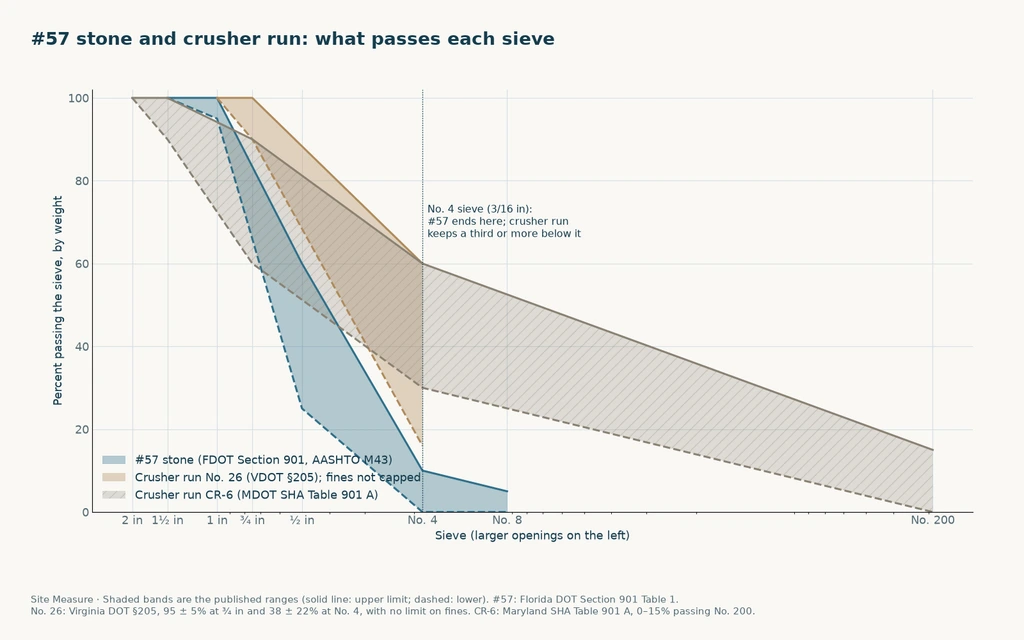
The names are specifications first and products second. #57 is a size designation from AASHTO M43, which state highway departments reprint in their own manuals (Florida DOT [2]): stone that passes a 1 in sieve and is caught on the No. 4, with very little smaller than that. Yards wash it, which is why you will also hear it called clean stone. Crusher run has no national size. The definition most yards follow in spirit is Virginia DOT’s [1]: an aggregate that “shall contain all of the sizes produced when the original aggregate is reduced through a series of crushers to the maximum size specified”. A 1 in crusher run therefore runs from an inch all the way down to dust.
| Sieve | Passing |
|---|---|
| 1½ in | 100% |
| 1 in | 95–100% |
| ½ in | 25–60% |
| No. 4 (4.75 mm, about 3/16 in) | 0–10% |
| No. 8 (2.36 mm) | 0–5% |
| Product | Specification | Percent passing | Fines (passing No. 200) | Note |
|---|---|---|---|---|
| Crusher run No. 25 | VDOT §205 | 1½ in: 100 min · 1 in: 95 ± 5 · No. 4: 32 ± 18 | Not limited | Liquid limit ≤ 25, plasticity index ≤ 3 |
| Crusher run No. 26 | VDOT §205 | 1 in: 100 min · ¾ in: 95 ± 5 · No. 4: 38 ± 22 | Not limited | — |
| Crusher run CR-6 | MDOT SHA Table 901 A | 2 in: 100 · 1½ in: 90–100 · ¾ in: 60–90 · No. 4: 30–60 | 0–15% | “Not to be used in the structural part of any Administration project”; up to 15% recycled asphalt allowed |
Read the two gradings next to each other and you will see the whole difference sits in one row. Both begin at about an inch. #57 is finished at the No. 4 sieve, a 3/16 in mesh. Crusher run still has a third or more of its weight below that sieve, and the Virginia specification does not limit how fine it goes. That tail of fines is the whole story: it is what lets crusher run compact, and what stops it draining.
Which job gets which stone
The easiest way to settle a debate about gravel, with your yard or with yourself, is to read what the engineers put on paper. The table shows where each material is named by the agencies that have to make it last for decades, and by the sellers quoted elsewhere on this site.
| Job | Use | Why | Work it out |
|---|---|---|---|
| Driveway or parking pad base | Crusher run | Virginia DOT uses crusher run for all-weather private access pavements; the fines lock under a compactor. | crusher run calculator |
| French drain or foundation drain | #57 stone | Texas DOT's default filter stone around underdrains; the code wants washed stone larger than the pipe slots. | French drain guide |
| Drywell, dry creek or stormwater reservoir | #57 stone | Stormwater manuals size #57 beds at 40% voids; fines would fill the voids that hold the water. | drainage guide |
| Shed pad | #57 stone | The shed sellers quoted on this site ask for ¾ in clean crushed stone (#57 or #67) in a timber frame, and rule out stone with fines. | shed base guide |
| Under a concrete slab | Either, by job | The code asks for a base course of clean graded sand, gravel or crushed stone; which one depends on drainage under the slab. | slab base guide |
| Pipe bedding and backfill | Crusher run | Named in Virginia DOT's own list of crusher run uses. | crusher run calculator |
| Paver base | Crusher run | The paver industry's base is a compacted dense-graded aggregate, which is what crusher run and road base are. | paver base calculator |
| Loose gravel surface you walk on | Either, by job | Clean stone drains and stays loose; a dense-graded mix compacts into a firm crust that needs edging and the odd top-up. | pea gravel calculator |
| Agency | Use |
|---|---|
| Minnesota Stormwater Manual | Reservoir layer under pervious concrete; a 4 in No. 57 base under permeable pavers; at least 4 in around underdrains in coarser stone beds |
| Virginia DEQ | Reservoir layer under porous concrete; 2 in bedding under porous asphalt; 4 in under the No. 8 bedding of permeable pavers |
| New Jersey DEP | Choker course of pervious paving: “clean, washed AASHTO No. 57 broken stone” |
| Maryland Department of the Environment | “The most widely used aggregate in SWM construction”: stone reservoirs, around underdrains, under permeable paving |
| North Carolina DOT | Shoulder drains, structural concrete, sediment control stone |
One theme runs through the tables. Where a specification wants water to move, it names washed #57 (Texas DOT [5], Maryland’s stormwater guide [4]). Where it wants a base or a surface to keep its shape under load, it names a dense-graded material with fines, which is what crusher run is (Virginia DOT [1]). Maryland’s highway specification [3] goes one step further: it keeps its crusher run, CR-6, out of the structural part of any project, and uses graded aggregate base, with a tighter cap on fines, for that work instead.
How much they weigh, and how much to order
Loose, they weigh almost the same. Our ledger has #57 at 2,400 and 2,410 lb per cubic yard (Gravelshop and Cummin Landscape Supply) and crusher run at 2,450 lb (Yard Works Landscape Supply). The order still differs, because crusher run is bought to be compacted. Washington State DOT [7] lists its crushed surfacing base at 2,950 lb per yard loose and 3,700 lb compacted, so a yard of finished base takes about 25% more loose material than the volume you measured. Clean stone is specified loose, so with #57 you order what you measure.
| Job | Volume | #57, loose | Crusher run, loose | Crusher run, to compact |
|---|---|---|---|---|
| 12 × 40 ft driveway base, 4 in | 5.93 yd³ | 7.1 t | 7.3 t | 9.1 t |
| 20 × 20 ft parking pad, 6 in | 7.41 yd³ | 8.9 t | 9.1 t | 11.4 t |
| 10 × 12 ft shed on a 12 × 14 ft pad, 4 in | 2.07 yd³ | 2.5 t | 2.5 t | 3.2 t |
| 12 × 12 ft patio base, 4 in | 1.78 yd³ | 2.1 t | 2.2 t | 2.7 t |
| 50 ft French drain, 12 × 18 in trench | 2.56 yd³ | 3.1 t | 3.1 t | 3.9 t |
For your own dimensions, the crusher run calculator has an extra-allowance field for that compaction and the #57 stone calculator does not; both open on the ledger weights above. To move between yards and tons for any product, the cubic yards to tons converter keeps every supplier weight in one table.
What they cost at the same yard
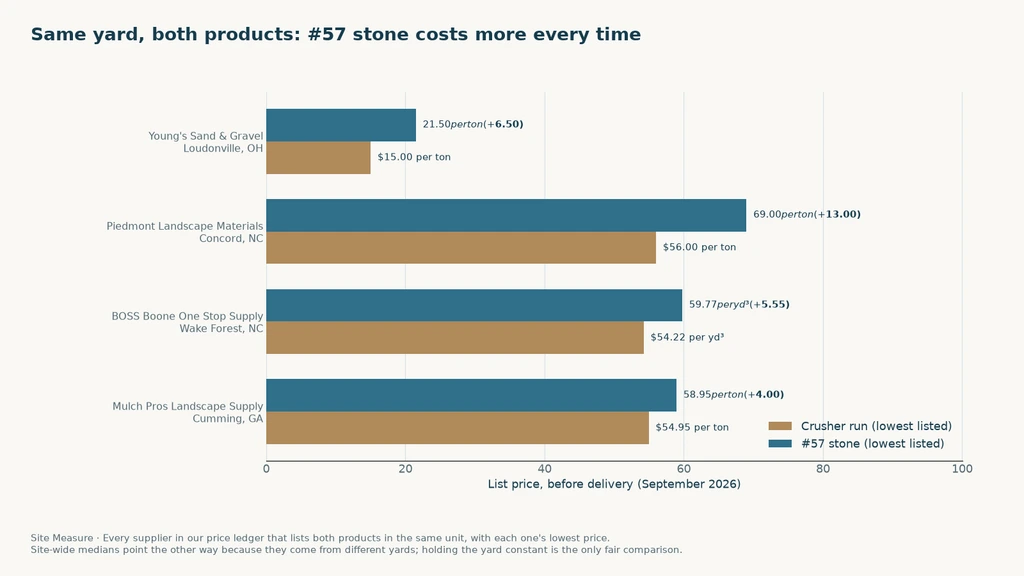
Site averages will lie to you on this one, so do not shop by them. Across our ledger the #57 median is $47.48 a ton and the crusher run median $55.48, so the washed stone looks like the better deal. Those two figures come from different yards in different states. Hold the yard constant, which is what you do when you buy, and the story flips: every supplier in the ledger that lists both charges more for #57, by $4 to $13 per ton or per yard. Washing costs money, and the dust screened out of #57 is product the yard sells as something else.
| Supplier | Location | Crusher run | #57 stone | #57 costs more by |
|---|---|---|---|---|
| Young's Sand & Gravel | Loudonville, OH | $15 per ton | $21.50 per ton | $6.50 |
| Piedmont Landscape Materials | Concord, NC | $56 per ton | $69 per ton | $13 |
| BOSS Boone One Stop Supply | Wake Forest, NC | $54.22 per yd³ | $59.77 per yd³ | $5.55 |
| Mulch Pros Landscape Supply | Cumming, GA | $54.95 per ton | $58.95 per ton | $4 |
The truck is the same either way, so on a small order delivery is the larger part of the bill for both materials. The dump truck load guide covers short-load fees and minimum orders, and gravel prices lists every row with the date it was recorded.
Using both on one job
Plenty of jobs use both, and yours may be one of them. A compacted crusher run base carries the load, with clean stone on top where you want drainage or a loose finish; under a slab it can run the other way, a clean course letting water out from beneath the concrete. The code’s base course for a slab is “clean graded sand, gravel, crushed stone or crushed blast-furnace slag” (IRC R506.2 [6]), and the gravel under a concrete slab guide works through that section. The one combination to avoid is fines where water has to pass. Crusher run around a drain pipe or in a drywell fills the voids the water needs; the stormwater manuals that size #57 beds at 40% voids (Virginia DEQ [8]) assume those voids are empty.
Local names for crusher run
Crusher run travels under local names, and the price ledger carries rows under several of them. Virginia’s dense-graded 21A and 21B are the exception: a graded base with a capped share of fines rather than a crusher run, so if you are quoted 21A you are not being quoted crush and run.
| Supplier | Location | Sold as | Price |
|---|---|---|---|
| Main's Landscape Supply | Southfield, MI | Limestone with fines 21AA | $65.99 per yd³ |
| Young's Sand & Gravel | Loudonville, OH | #310 Crusher Run | $15 per ton |
| Piedmont Landscape Materials | Concord, NC | ABC Stone | $56 per ton |
| BOSS Boone One Stop Supply | Wake Forest, NC | Crusher Run (ABC) | $54.22 per yd³ |
| Down To Earth Materials | Gray, TN | Crusher Run | $57 per ton |
| Mulch Pros Landscape Supply | Cumming, GA | Crush & Run | $54.95 per ton |
How these figures were worked out
- Volume = length × width × depth ÷ 12 ÷ 27 for the pads and bases; the shed pad and the drain trench use the figures from their own guides.
- Tons = yd³ × lb per yd³ ÷ 2,000 at the ledger weights: 2,400–2,410 lb for #57, 2,450 lb for crusher run, loose.
- Crusher run to compact = loose tons × 3,700 ÷ 2,950 (WSDOT Exhibit 620-1), about 25% more.
- Price pairs take each supplier’s lowest listed price for each product in the same unit; medians cover every per-ton row in the ledger for that product.
Questions
Is crusher run the same as ABC, 21AA, CR-6 or #310?
Same idea, local name. North Carolina sells it as ABC (aggregate base course), Michigan as 21AA, Maryland as CR-6 and Georgia as #310, and the price ledger on this site has rows under each. Virginia’s dense-graded 21A and 21B are a tighter relative: a graded base with a capped share of fines, not a crusher run.
Can I put #57 stone on a driveway?
You can, and people do, but the specifications do not: Virginia DOT names crusher run, not clean stone, for all-weather private access pavements. Clean #57 has nothing to bind it, so it stays loose under tyres and needs an edge to stop it spreading. For a surface that packs firm, go with crusher run; for one that drains and stays open, go with #57 and be ready to rake it.
Does crusher run drain?
Slowly. The dust and fines that let it compact also fill the spaces between the stones, which is why the stormwater manuals specify washed #57 for reservoirs and underdrains and size them at about 40% voids. Crusher run sheds water off its compacted surface rather than letting it through.
How much extra crusher run do I order for compaction?
About a quarter more. Washington State DOT’s design manual lists crushed surfacing base at 2,950 lb per cubic yard loose and 3,700 lb compacted, so one compacted yard takes about 1.25 loose yards. The crusher run calculator has an extra-allowance field for exactly this; the #57 calculator applies none, because clean stone is specified by its loose volume.
Sources
- Virginia DOT: Road and Bridge Specifications 2020, §205 Crusher Run Aggregate and Table II-9
Defines crusher run as all the sizes the crushers produce; lists its uses; gradings for No. 25 and No. 26 and for dense-graded 21A/21B. Read November 8, 2026.
- Florida DOT: Section 901, Table 1, Standard Sizes of Coarse Aggregate
AASHTO M43 gradings, including No. 57: 1 in to No. 4, 0–10% passing No. 4. Read November 8, 2026.
- Maryland DOT State Highway Administration: 2026 Standard Specifications, Table 901 A
Crusher run CR-6 and graded aggregate base gradings; CR-6 not for the structural part of a project. Read November 8, 2026.
- Maryland Department of the Environment: Guide to Common Construction Materials and Components
No. 57 as the most widely used aggregate in stormwater construction; No. 10 screenings as structural fill, not a filter. Read November 8, 2026.
- Texas DOT: 2024 Standard Specifications, Item 556 Pipe Underdrains
Type G (Grade 4, #57) filter material around underdrains unless the plans say otherwise. Read November 8, 2026.
- International Code Council: 2024 International Residential Code, R405.1 and R506.2
Foundation drains: washed gravel or crushed rock one sieve size larger than the pipe perforation. Slab base course: clean graded sand, gravel, crushed stone or crushed blast-furnace slag. Read November 8, 2026.
- Washington State DOT: Design Manual M 22-01.23, Exhibit 620-1
Crushed surfacing base course: 2,950 lb per yd³ loose, 3,700 compacted. Read November 8, 2026.
- Virginia DEQ: Stormwater Design Specification No. 7, v2.0
Design porosity of 0.4 for No. 57 stone reservoirs. Read November 8, 2026.
- North Carolina DOT: 2018 Standard Specifications, Table 1005-1
Aggregate gradations and uses, including No. 57 and ABC. Read November 8, 2026.
Every figure on this page links to its source; recorded dates are shown with the figures or in the gravel weight and price ledgers, and the arithmetic is covered by automated tests. How we source and calculate · Report an error