THE SHORT ANSWER
4–6 in of ¾ in clean crushed stone, 1 ft past the shed, in a frame.
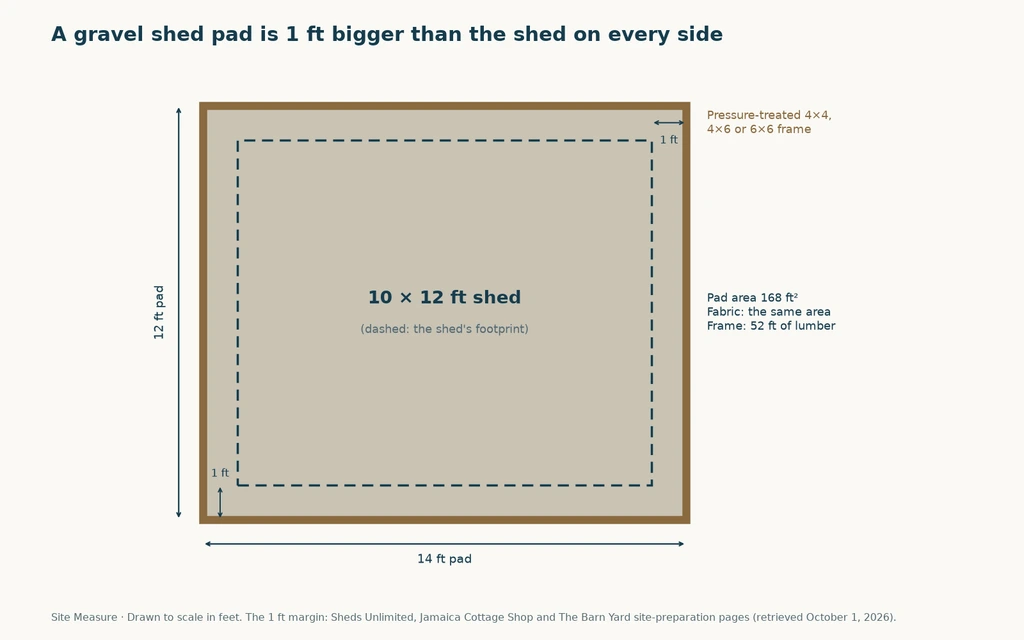
Dig out the turf, set a level frame of pressure-treated timbers pinned with rebar, line it with fabric and fill it with ¾ in clean crushed stone, compacted. For a 10 × 12 ft shed the pad is 12 × 14 ft: about 2.07 yd³ (2.7–2.9 t) of stone at 4 in, or 3.11 yd³ (4.0–4.4 t) at 6 in. At the median list price that stone costs about $115–$124 to $173–$186 before delivery.
Most shed sellers deliver onto a pad you build, and the ones quoted here all ask for the same thing: a level bed of crushed stone inside a timber frame. The stone drains, so the floor never sits in water; the frame stops the stone from spreading, so the pad stays level. Below is what to buy, how to build it, and how much stone your size takes. The steps come from the sellers’ own site-preparation guides, read on November 7, 2026; the weights and prices come from our ledgers, recorded September 23, 2026.
What you need for a 10 × 12 shed base
- Stone: 2.07 yd³ of ¾ in clean crushed stone for 4 in, 3.11 yd³ for 6 in (2.7–4.4 t). That is 112 to 168 bags of 0.5 ft³, so order it in bulk.
- Frame: pressure-treated 4×4, 4×6 or 6×6 timbers, 52 ft per course around a 12 × 14 ft pad, and 4 in exterior screws to join the courses.
- Rebar: ½ in stakes at least 24 in long, one about every 6 ft: 9 for this frame.
- Fabric: weed barrier or stabilization fabric for 168 ft², plus a couple of inches up the inside of the frame.
- Tools: shovel, wheelbarrow, garden rake, tape, level (string, laser or 4 ft), drill with a ½ in auger bit, sledgehammer, circular saw, and a hand tamper or a rented plate compactor.
The list follows Sheds Unlimited [1] and Jamaica Cottage Shop [2]. For another size, the table below gives the pad, frame length, stakes and stone.
How to build a gravel shed base, step by step
- Pick and clear the spot. Choose the highest, driest part of the yard with room for the delivery truck. Call 811 first; Sheds Unlimited says not to dig within 2 ft of a marked utility line.
- Mark the pad. Stake out the shed size plus 1 ft on every side and check that the two diagonals match, which makes the corners square.
- Check the slope. Run a string level corner to corner. If the ground falls more than 6 in across the pad, level the site before you dig (see building on a slope).
- Dig. Strip the turf and topsoil and dig to the depth of your stone. Pack the soil firm.
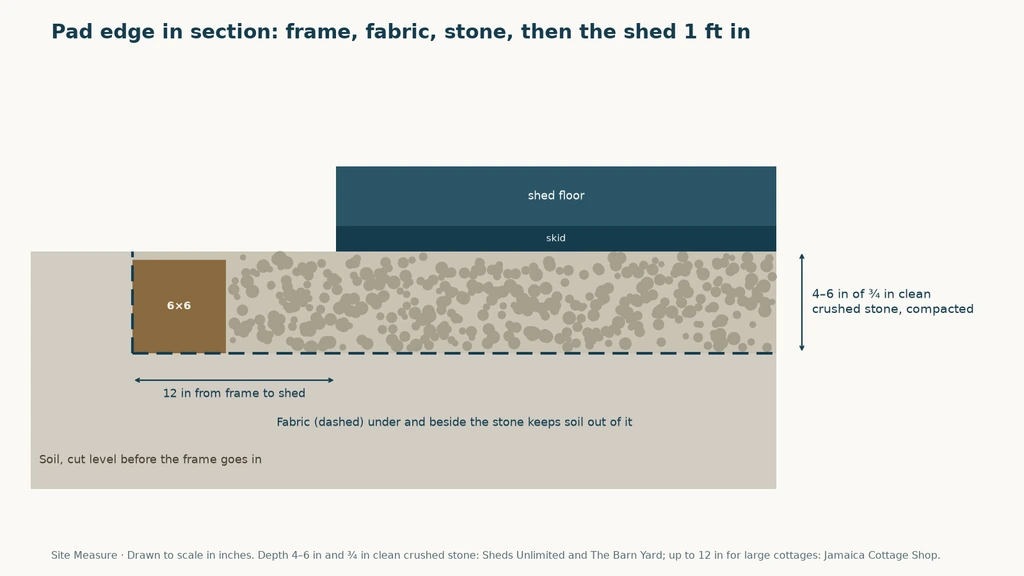
- Build the frame. Lay the first course of timbers level, check the diagonals again, then stack the next course with the joints offset and screw the courses together about every 2 ft. Drill through and drive rebar about every 6 ft.
- Line it. Lay fabric over the soil inside the frame and staple it a couple of inches up the sides, so soil cannot work up into the stone.
- Fill and compact. Spread the stone in layers of about 4 in, rake each one level and compact it, working from the outside in. Stop when the stone is level with the top of the frame.
- Check level, then set blocks if you use them. Put a level across the pad in both directions. If your shed maker asks for blocks, set them now at the corners and under the posts.
The order is Jamaica Cottage Shop’s, with Sheds Unlimited’s utility and compaction notes. A pad that is out of level passes the slope straight to the shed, so take the time at the frame stage: it is far easier to fix a timber than a full bed of stone.
How big and how deep the pad should be
The sellers agree on the stone and the margin and differ a little on depth. Larger and heavier buildings go deeper.
| Seller | Stone | Depth | Pad size |
|---|---|---|---|
| Sheds Unlimited (PA) [1] | ¾ in clean stone; no river stone or small stone | At least 4 in; 4–6 in, deeper for a larger shed | 18 in–2 ft longer and wider than the shed |
| Jamaica Cottage Shop (VT) [2] | ¾ in clean crushed stone | 6 in for small sheds, up to 12 in for cottages | The building plus a foot on every side |
| The Barn Yard (New England) [3] | ¾ in crushed stone | 4–6 in | 1 ft larger than the footprint on each side |
| Old Hickory dealer (ON) [4] | Crushed stone, tamped | 8–12 in | Organic soil removed 2 ft wider and longer |
A shed of 200 ft² of floor or less is exempt from a building permit under 2021 IRC R105.2 [5], which counts the floor, not the pad; many towns change that limit or still apply setbacks, so check before you dig.
Building a gravel shed base on a slope
A frame can make up a gentle slope; a steep one needs digging first. Jamaica Cottage Shop [2] puts the line at 6 in: if the ground falls more than that across the pad, level the site before you start, and expect frame walls 8–18 in high depending on the timber and the number of courses. One course will not correct a real slope.
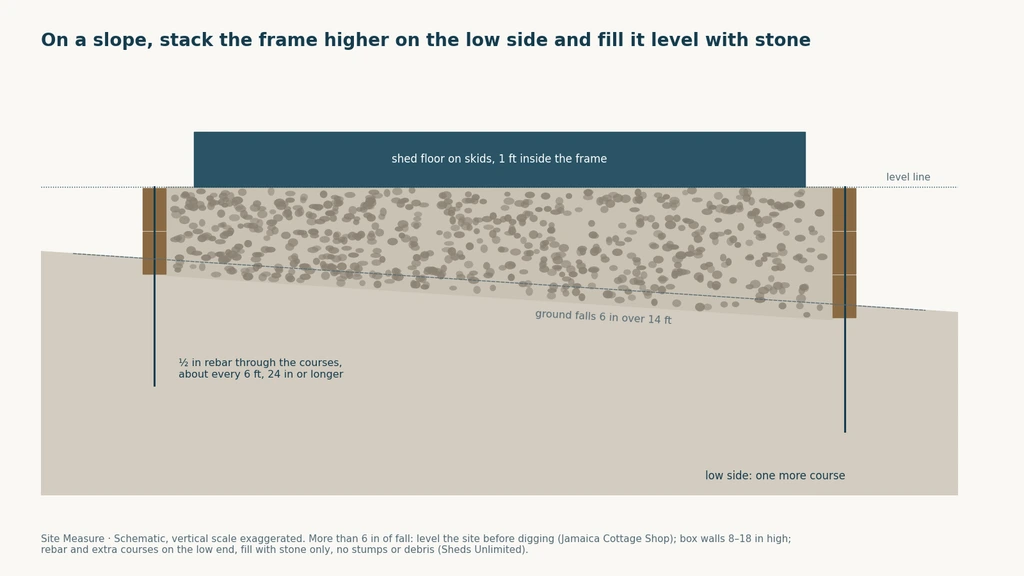
Sheds Unlimited [1] adds courses on the low end, sets them a few inches into the ground, braces a tall side with deadmen, and fills the whole box with stone: never with stumps, limbs or other debris, which rot and let the pad settle.
Which stone: clean crushed, not pea gravel or crusher run
| Stone | What it is | Under a shed |
|---|---|---|
| ¾ in clean crushed, #57 | Angular stone with the fines washed out; ¾ in clean matches AASHTO No. 67 or No. 57 [6] | What every seller above asks for: it locks when compacted and drains |
| Crusher run | Every size the crusher makes, dust included (Virginia DOT [7]) | Packs very hard, but its fines slow drainage under the floor |
| Pea gravel, river stone | Rounded stone | Ruled out by Sheds Unlimited: it rolls instead of locking |
Clean stone and crusher run cost about the same by the ton in our ledger, so choose on drainage, not price.
How much stone for your shed size
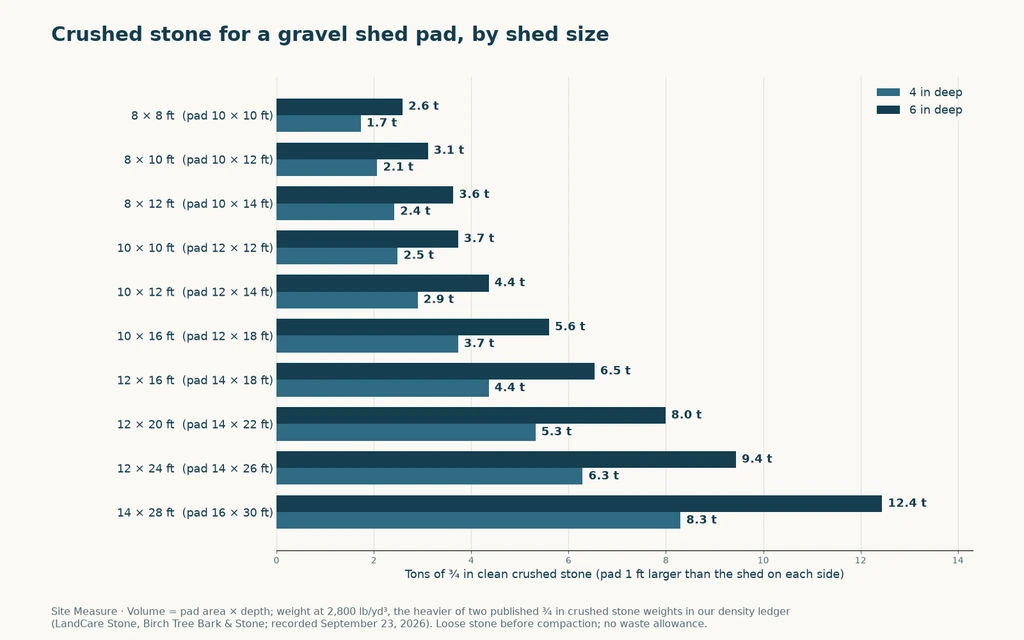
Volume is the pad area times the depth; weight uses the two ¾ in crushed stone figures in our ledger, 2,600 and 2,800 lb per cubic yard (LandCare Stone and Birch Tree Bark & Stone). These are loose volumes with no waste allowance, so round up when you order.
| Shed | Pad | Frame per course | Rebar stakes | 4 in: yd³ · tons | 6 in: yd³ · tons |
|---|---|---|---|---|---|
| 8 × 8 ft | 10 × 10 ft (100 ft²) | 40 ft | 7 | 1.23 · 1.6–1.7 t | 1.85 · 2.4–2.6 t |
| 8 × 10 ft | 10 × 12 ft (120 ft²) | 44 ft | 8 | 1.48 · 1.9–2.1 t | 2.22 · 2.9–3.1 t |
| 8 × 12 ft | 10 × 14 ft (140 ft²) | 48 ft | 8 | 1.73 · 2.2–2.4 t | 2.59 · 3.4–3.6 t |
| 10 × 10 ft | 12 × 12 ft (144 ft²) | 48 ft | 8 | 1.78 · 2.3–2.5 t | 2.67 · 3.5–3.7 t |
| 10 × 12 ft | 12 × 14 ft (168 ft²) | 52 ft | 9 | 2.07 · 2.7–2.9 t | 3.11 · 4.0–4.4 t |
| 10 × 16 ft | 12 × 18 ft (216 ft²) | 60 ft | 10 | 2.67 · 3.5–3.7 t | 4.00 · 5.2–5.6 t |
| 12 × 16 ft | 14 × 18 ft (252 ft²) | 64 ft | 11 | 3.11 · 4.0–4.4 t | 4.67 · 6.1–6.5 t |
| 12 × 20 ft | 14 × 22 ft (308 ft²) | 72 ft | 12 | 3.80 · 4.9–5.3 t | 5.70 · 7.4–8.0 t |
| 12 × 24 ft | 14 × 26 ft (364 ft²) | 80 ft | 14 | 4.49 · 5.8–6.3 t | 6.74 · 8.8–9.4 t |
| 14 × 28 ft | 16 × 30 ft (480 ft²) | 92 ft | 16 | 5.93 · 7.7–8.3 t | 8.89 · 11.6–12.4 t |
For a pad not in the table, enter its length, width and depth in the crushed stone calculator. Sheds over 200 ft² of floor (12 × 20 ft and up here) are past the IRC permit exemption.
What a gravel shed base costs
We recorded 10 list prices for ¾ in clean crushed stone and #57 on September 23, 2026. By the ton they run $21.50 to $69, median $42.75 (6 prices); by the cubic yard $33 to $174.99 (4 prices). Delivery is extra on every list.
| Supplier | Location | Product | Price | Terms |
|---|---|---|---|---|
| R.J. Grondin & Sons | Gorham, ME | 3/4 inch Crushed Stone | $24 per ton | Loaded at the pit; delivery extra |
| R.J. Grondin & Sons | Gorham, ME | 3/4 inch Crushed Stone | $33 per yd³ | Loaded at the pit; delivery extra |
| Main's Landscape Supply | Southfield, MI | Crushed Limestone 6A, 3/4 inch clean | $71.99 per yd³ | Delivery extra |
| Young's Sand & Gravel | Loudonville, OH | #57 Gravel (washed) | $21.50 per ton | Pickup; delivery quoted |
| Young's Sand & Gravel | Loudonville, OH | #57 Limestone | $36 per ton | Pickup; delivery quoted |
| Bracht Bros | Forest Lake, MN | Tan Limestone 3/4 inch Clean | $49.50 per ton | Pickup; plus county tax |
| Piedmont Landscape Materials | Concord, NC | 57 Stone | $69 per ton | Delivery from $50 |
| BOSS Boone One Stop Supply | Wake Forest, NC | Clean (Washed) Stone #57 | $59.77 per yd³ | Delivery at checkout |
| Mulch Pros Landscape Supply | Cumming, GA | #57 Stone | $58.95 per ton | Free pickup; delivery per mile |
| Texas Garden Materials | Houston, TX | Limestone Gravel 3/4 inch, washed | $174.99 per yd³ | Pickup; delivery at checkout |
| Shed | 4 in at the median | 4 in, lowest to highest | 6 in at the median | 6 in, lowest to highest |
|---|---|---|---|---|
| 8 × 8 ft | $69–$74 | $35–$119 | $103–$111 | $52–$179 |
| 8 × 10 ft | $82–$89 | $41–$143 | $124–$133 | $62–$215 |
| 8 × 12 ft | $96–$103 | $48–$167 | $144–$155 | $72–$250 |
| 10 × 10 ft | $99–$106 | $50–$172 | $148–$160 | $75–$258 |
| 10 × 12 ft | $115–$124 | $58–$200 | $173–$186 | $87–$301 |
| 10 × 16 ft | $148–$160 | $75–$258 | $222–$239 | $112–$386 |
| 12 × 16 ft | $173–$186 | $87–$301 | $259–$279 | $130–$451 |
| 12 × 20 ft | $211–$228 | $106–$367 | $317–$341 | $159–$551 |
| 12 × 24 ft | $250–$269 | $126–$434 | $375–$403 | $188–$651 |
| 14 × 28 ft | $329–$355 | $166–$572 | $494–$532 | $248–$859 |
The stone is the small part of the bill. Sheds Unlimited prices a built pad at about $5 per square foot, “around $600” for an 8 × 10 shed and “around $840” for a 10 × 12, which covers digging, timber, fabric and labour. A few tons is also a short load for most yards; the dump truck load guide shows how the price per ton falls as the order grows.
Gravel, blocks or a concrete slab?
| Foundation | What the sellers say |
|---|---|
| Gravel pad | Drains well, does not settle easily, cost-effective and easy to install; suits smaller outbuildings |
| Gravel pad with blocks | Blocks at the corners and under each post (Jamaica Cottage Shop); an optional extra support (Sheds Unlimited) |
| Concrete slab | “even more support”, but “typically far more expensive and difficult to install” (Jamaica Cottage Shop); usually needs a contractor (Sheds Unlimited) |
If you do pour a slab, the gravel under a concrete slab guide covers the base course the code asks for underneath it.
How these figures were worked out
- Pad = (shed length + 2 ft) × (shed width + 2 ft); frame per course = pad perimeter; stakes = perimeter ÷ 6 ft, rounded up.
- Stone ft³ = pad area × depth ÷ 12; yd³ = ft³ ÷ 27; bags = ft³ ÷ 0.5, rounded up.
- Tons = yd³ × 2,600 or 2,800 lb ÷ 2,000. Loose volume; no waste allowance.
- Cost = tons × the per-ton list price (median $42.75, lowest $21.50, highest $69); delivery and tax excluded.
Questions
Can I use pea gravel for a shed base?
The shed sellers quoted here say no. Sheds Unlimited rules out smooth river stone and small stones, and Jamaica Cottage Shop asks for crushed stone whose angular edges lock together when compacted. Rounded pea gravel keeps rolling under load.
Do I need a permit for a shed on a gravel pad?
Under the 2021 International Residential Code, R105.2, a one-story detached accessory structure with a floor area of 200 square feet or less is exempt from a permit, but the exemption does not excuse work that breaks other rules, such as setbacks. Many places adopt different limits, so ask your building department.
Should the gravel pad sit above the ground or below it?
Either works. Sheds Unlimited sets the stone a few inches into the ground inside the frame; Jamaica Cottage Shop notes that a pad sitting partly above ground needs less digging, and fills until the stone is level with the frame or the surrounding soil. Pick the highest spot in the yard so water runs away from it.
Do I need concrete blocks on a gravel shed pad?
Not always. Jamaica Cottage Shop sets one block at each corner and one under each post of its buildings; Sheds Unlimited lists blocks set into the gravel as an optional extra support. Follow your shed maker’s instructions for skids or floor beams.
Sources
- Sheds Unlimited: Building a Gravel Shed Pad, Step-by-Step Guide
¾ in clean stone 4–6 in deep, pad 18 in–2 ft larger, stacked pressure-treated frame, ½ in rebar at least 24 in long about every 6 ft, fabric, compactor; about $5 per ft² built; 811 and 2 ft from utility lines. Read November 7, 2026.
- Jamaica Cottage Shop: Building Gravel Foundations for Sheds and Cottages (September 29, 2023)
Clean ¾ in crushed stone 6 in for small sheds, up to 12 in for cottages, in about 4 in compacted layers; frame screwed every 2 ft, rebar every 6 ft; level a slope over 6 in first; box walls 8–18 in; blocks at corners and posts. Read November 7, 2026.
- The Barn Yard: Site Preparation
¾ in crushed stone, 4–6 in deep, 1 ft larger than the footprint on each side. Read November 7, 2026.
- Old Hickory Buildings Deep River: Getting ready for your new building
8–12 in of tamped crushed stone; organic material removed from an area 2 ft wider and longer; no standing water. Read November 7, 2026.
- International Code Council: 2021 International Residential Code, R105.2 Work exempt from permit
One-story detached accessory structures up to 200 ft² of floor area are exempt from a permit. Read November 7, 2026.
- Florida DOT: Section 901, Table 1, Standard Sizes of Coarse Aggregate
AASHTO No. 57 (1 in to No. 4) and No. 67 (¾ in to No. 4) size ranges. Read November 7, 2026.
- Virginia DOT: Road and Bridge Specifications 2020, §205 Crusher Run Aggregate
Crusher run contains every size the crushers produce, fines included. Read November 7, 2026.
Every figure on this page links to its source; recorded dates are shown with the figures or in the gravel weight and price ledgers, and the arithmetic is covered by automated tests. How we source and calculate · Report an error