THE SHORT ANSWER
Check the city first, then plan 6 in of compacted road base.
Cities disagree: La Cygne, Kansas, accepts six inches of gravel for residential parking, while Marshall, Missouri, requires new residential parking to be paved. Where gravel is allowed, a space is at least 9 × 20 ft, and FHWA’s thinnest light-traffic gravel layer is 4.5 in. A two-car pad, 18 × 20 ft at 6 in compacted, takes about 8.36 yd³ or 10.5–12.5 t of road base, roughly $449–$539 before delivery.
A gravel parking pad is a compacted gravel surface beside or off a driveway where cars, a trailer or a boat stand. Unlike the driveway itself, it carries parked weight more than traffic, but it falls under the same local parking rules. The rules below are quoted from three city codes read on November 7, 2026; the depths come from FHWA’s gravel roads guide and those codes, and the tons and costs from our ledgers, recorded September 23, 2026.
Is a gravel parking pad allowed?
It depends on the city, and the three codes below cover the range from allowed to not allowed. Look up the off-street parking or driveway surfacing section of your own zoning code, and ask about existing gravel: La Cygne and Marshall both keep older gravel areas legal.
| City | Gravel parking? | What the code says |
|---|---|---|
| La Cygne, KS [2] | Allowed | Residential parking “may also be surfaced and maintained with six (6) inches of gravel, including base”, as an alternative to 4 in of asphalt or concrete |
| Portland, OR [3] | Not near the street | Parking and driveways for buildings within 150 ft of the street go on concrete, asphalt over 4 in of crushed stone or gravel, or permeable pavers; a driveway to a building farther back may use 8 in of 1 in minus compacted crushed gravel past its first 40 ft |
| Marshall, MO [1] | Not for new residential parking | New parking in the R-1 to R-3 districts “shall be paved”, with “a dust-free, hard all-weather surface”; areas that existed by July 6, 1987 are exempt |
How big a parking pad should be
Marshall’s code [1] sets the size of a required space: a required off-street space is “at least nine (9) feet wide and twenty (20) feet long.” Side by side, a pad for two cars is 18 × 20 ft. Your own code may set a different stall size or ask for more width beside a wall or fence.
| Cars | Pad | Area |
|---|---|---|
| 1 car | 9 × 20 ft | 180 ft² |
| 2 cars | 18 × 20 ft | 360 ft² |
| 3 cars | 27 × 20 ft | 540 ft² |
| 4 cars | 36 × 20 ft | 720 ft² |
How deep the gravel should be
FHWA’s gravel roads guide [4] (Table 3) suggests a minimum gravel layer by how well the soil underneath carries load. A parking pad sees fewer than five heavy trucks a day, the guide’s lightest band:
| Source | Condition | Gravel depth |
|---|---|---|
| FHWA Table 3 | Low-support subgrade, 0–5 heavy trucks a day | 6.5 in |
| FHWA Table 3 | Medium-support subgrade, 0–5 heavy trucks a day | 5.5 in |
| FHWA Table 3 | High-support subgrade, 0–5 heavy trucks a day | 4.5 in |
| La Cygne, KS | Residential parking | 6 in, including base |
| Portland, OR | Private driveway past its first 40 ft | 8 in of 1 in minus, over filter fabric |
If the ground stays soft when wet, use FHWA’s low-support figure, 6.5 in. Portland also asks for every parking surface to sit on “properly drained, well-compacted subgrade, that is free of organic materials”, so strip the topsoil first.
Which gravel to use
FHWA separates two jobs. Base gravel has larger stone and few fines, which gives it strength and drainage, but left on top “it will not form a crust to keep the material bound together”. A surface gravel needs the opposite: “A good gravel road needs gravel with sufficient fine material which has a plastic or “binding” characteristic”. For a pad, that usually means a graded road base or crusher run, compacted, rather than clean stone such as #57. The driveway calculator compares base and surface layers by state name.
How much gravel to order for a parking pad
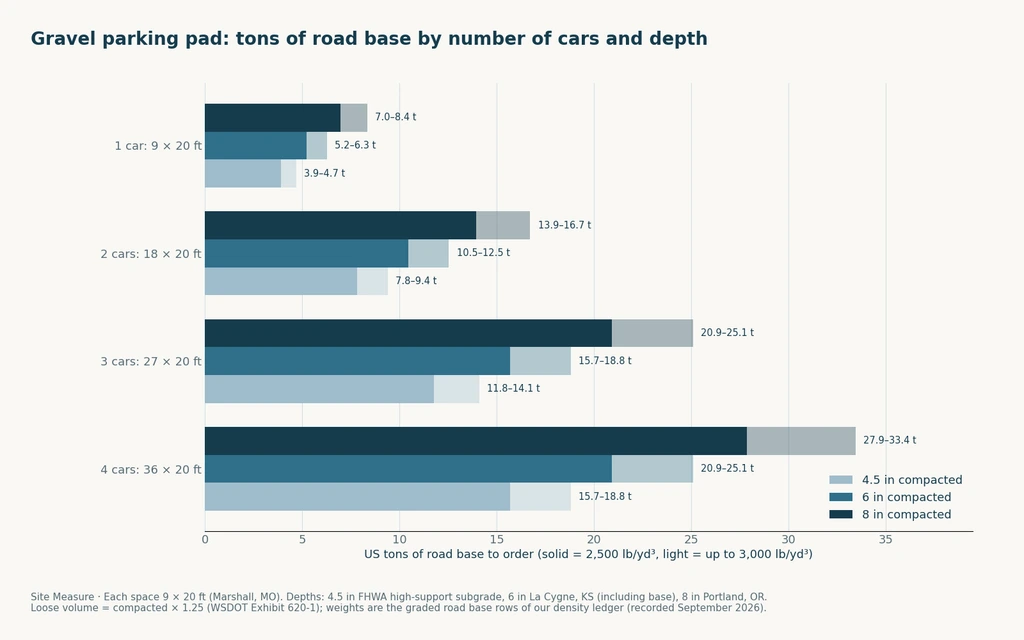
Compacted gravel takes more loose stone than its finished volume: WSDOT lists crushed base at 2,950 lb/yd³ loose and 3,700 lb/yd³ compacted, a factor of 1.25. The table orders that loose volume and weighs it at 2,500–3,000 lb/yd³, the 7 road base weights in our ledger.
| Pad | 4.5 in: yd³ · tons | 6 in: yd³ · tons | 8 in: yd³ · tons |
|---|---|---|---|
| 1 car, 9 × 20 ft | 3.14 · 3.9–4.7 t | 4.18 · 5.2–6.3 t | 5.57 · 7.0–8.4 t |
| 2 cars, 18 × 20 ft | 6.27 · 7.8–9.4 t | 8.36 · 10.5–12.5 t | 11.15 · 13.9–16.7 t |
| 3 cars, 27 × 20 ft | 9.41 · 11.8–14.1 t | 12.54 · 15.7–18.8 t | 16.72 · 20.9–25.1 t |
| 4 cars, 36 × 20 ft | 12.54 · 15.7–18.8 t | 16.72 · 20.9–25.1 t | 22.30 · 27.9–33.4 t |
A one-car pad at 4.5 in is under 5 t, below many yards’ minimum load; see the dump truck load guide for short-load fees. For any other size, the road base calculator applies the same compaction factor.
What a gravel parking pad costs in stone
At the $43 per ton median of the 8 crusher run and road base list prices we recorded on September 23, 2026 (lowest $15, highest $57), before delivery:
| Pad | 4.5 in | 6 in | 8 in |
|---|---|---|---|
| 1 car | $169–$202 | $225–$270 | $300–$360 |
| 2 cars | $337–$404 | $449–$539 | $599–$719 |
| 3 cars | $506–$607 | $674–$809 | $899–$1,079 |
| 4 cars | $674–$809 | $899–$1,079 | $1,198–$1,438 |
That is the stone only. The gravel driveway cost guide covers installed prices, which add excavation, grading and labour.
How these figures were worked out
- Pad = number of cars × 9 ft wide, × 20 ft long.
- Compacted yd³ = pad ft² × depth (in) ÷ 12 ÷ 27; loose yd³ = compacted × 3,700 ÷ 2,950.
- Tons = loose yd³ × 2,500 or 3,000 lb ÷ 2,000. Cost = tons × the per-ton median; delivery, tax and labour excluded.
Questions
Can I park on gravel in my front yard?
Only if your city allows it. La Cygne, Kansas, accepts six inches of gravel for residential parking, Marshall, Missouri, requires new residential parking to be paved, and Portland, Oregon, does not list plain gravel as a parking surface near the street. Ask your zoning office before you dig.
Is crusher run or #57 better for a parking pad?
Crusher run, or another graded road base, because #57 is clean stone without the fines that bind. FHWA’s gravel roads guide says a good surface gravel needs “sufficient fine material which has a plastic or ‘binding’ characteristic”, and that base gravel left on top “will not form a crust to keep the material bound together”.
Do I need fabric under a gravel parking pad?
None of the sources here requires it for a short pad. Portland puts its 8 inch crushed gravel driveway section over filter fabric, and asks for every parking surface to sit on a well-compacted subgrade free of organic material.
Sources
- City of Marshall, MO: Zoning Code §405.1120 Off-Street Parking (via Zoneomics)
Spaces at least 9 ft wide and 20 ft long; new parking in R-1 to R-3 must be paved with a dust-free, hard all-weather surface; paving layers from 6 in of rolled stone base. Read November 7, 2026.
- City of La Cygne, KS: Ordinance 1459, Zoning Article 22, ¶22-303 Surfacing (2018)
Residential parking may be surfaced with 4 in of asphalt or concrete, or with six inches of gravel, including base. Read November 7, 2026.
- City of Portland, OR: Code Chapter 24.45 Parking and Driveway Surfaces
Parking near the street on concrete, asphalt over 4 in of crushed stone, or permeable pavers; beyond 40 ft on a long driveway, 8 in of 1 in minus compacted crushed gravel over filter fabric. Read November 7, 2026.
- FHWA/SD LTAP: Gravel Roads Construction & Maintenance Guide (FHWA-OTS-15-0002, 2015)
Table 3 suggested minimum gravel layer thickness; Sections 3.2–3.3 on base versus surface gravel. Read November 7, 2026.
Every figure on this page links to its source; recorded dates are shown with the figures or in the gravel weight and price ledgers, and the arithmetic is covered by automated tests. How we source and calculate · Report an error