WHAT SHOULD YOU BUDGET?
Separate the gravel bill from the installed driveway price.
For an illustrative 12 × 40 ft layer at 3 inches deep, a density of 105 lb/ft³ gives 6.3 US tons. At an assumed $35 per ton plus $150 for one delivery, material and delivery total $370.50, or $0.77 per sq ft. This excludes extra allowance, tax, labor, excavation, drainage, equipment and other fees. It is a worked budget, not a 2026 market average or a full installation quote.
Someone searching “gravel driveway cost” may be pricing a top-up, replacing a failed layer or building a driveway from bare ground. Those are different scopes. First ask whether you need a material order or a complete contractor estimate. Our gravel driveway cost calculator helps with material quantities and an entered supplier quote; it does not price all the site work.
What do actual 2026 gravel price lists show?
The following entries come from dated supplier PDFs checked on . They are local product examples, not equivalent products, a national price range or a recommendation that either material suits your driveway.
| Source / location | Product & price basis | Listed price | Source date |
|---|---|---|---|
| R.J. Grondin, Maine [1] | 1½-inch crushed gravel, code 013, Brandy Brook / ton | $14.50 | Apr 13, 2026 |
| R.J. Grondin, Maine [1] | Same product, Windham / cubic yard | $18.00 | Apr 13, 2026 |
| Main’s, Southfield, Michigan [2] | 21AA limestone with fines / cubic yard, retail column | $65.99 | Apr 1, 2026 |
Grondin’s two entries are for different plants and units. Do not divide those prices to infer density. Main’s separately lists large-load, non-residential direct-ship prices; those are not the retail cubic-yard price shown here. Confirm availability, current pricing and all applicable charges with the supplier before ordering.
2026 source timeline
- April 1: date printed on the Main’s gravel and delivery pages used here.
- April 13: effective date shown on Grondin’s price list.
- September 17: Site Measure checked both documents and published this comparison.
This timeline establishes when the evidence was published and checked. It is not a price-trend series; we do not have comparable historical quotes that would support a claim that gravel prices rose or fell.
Worked example: gravel for a 12 × 40 ft driveway layer
Illustrative project, not a customer case study. The dimensions, density, allowance and quote below are hypothetical inputs. No driveway was built or measured for this example, and there is no actual order or observed leftover quantity.
1. Define the area and layer you are estimating
Assume a rectangular area 12 feet wide and 40 feet long, with one 3-inch layer to estimate. The footprint is 480 square feet. For your own project, record dimensions for each section and exclude areas you will not cover. Split an irregular footprint into separate areas rather than treating its widest dimensions as a complete rectangle.
The 3-inch input is a geometric calculation depth. It is not a specification for a finished driveway or a promise that loose gravel will retain that depth after compaction. Confirm the layer design and loose-to-compacted quantity with your installer or supplier before turning an estimate into an order.
2. Convert the layer to cubic yards and US tons
Measure each layer separately, convert its volume to the supplier’s selling unit, and apply the quote to the unrounded quantity. A density of 105 lb/ft³ is our calculator’s starting assumption; replace it with the actual product value.
US tons = cubic yards × 27 × density (lb/ft³) ÷ 2,000
The weight unit here is a US short ton of 2,000 lb, not a metric tonne. NIST unit definitions [3].
| Budget line | Calculation | Result |
|---|---|---|
| Area | 12 × 40 | 480 ft² |
| Geometric volume | 480 × 3 ÷ 324 | 4.444… yd³ |
| Weight | 120 ft³ × 105 ÷ 2,000 | 6.3 US tons |
| Material | 6.3 × $35 | $220.50 |
| Delivery | One assumed trip | $150.00 |
| Material + delivery | $220.50 + $150 | $370.50 |
This 3-inch layer is an arithmetic scenario, not a recommended driveway section. A new driveway can involve multiple specified layers and site work; calculate the materials separately and have an installer determine the construction requirements.
To check the units by hand: 3 inches ÷ 12 = 0.25 feet; 480 ft² × 0.25 ft = 120 ft³; and 120 ft³ ÷ 27 = 4.444… yd³. At the assumed 105 lb/ft³, that volume weighs 12,600 lb, or 6.30 US tons. Keep the full precision until the final purchasing and currency steps.
3. Separate allowance from order rounding
Suppose you choose a 10% extra allowance for this exercise. Multiply the calculated quantity by 1.10: 4.444… yd³ becomes 4.888… yd³, and 6.30 tons becomes 6.93 tons. This is a chosen planning margin, not a measured loss or universal compaction factor. Do not add it again if your supplier’s recommended order already includes an allowance for the same reason.
| Planning stage | US tons | Material | With delivery |
|---|---|---|---|
| Geometric estimate | 6.30 | $220.50 | $370.50 |
| With chosen 10% allowance | 6.93 | $242.55 | $392.55 |
| If ordering in whole-ton increments | 7.00 | $245.00 | $395.00 |
Whole-ton increments are an additional hypothetical condition, not a standard supplier rule. In that scenario, rounding 6.93 to 7 tons adds $2.45. The 7-ton order is 0.70 ton above the geometric estimate, but that difference is not a prediction of leftover gravel: density, ground levels and installation conditions remain unverified. Ask whether billing uses ordered quantity or the actual delivered scale weight.
4. Check what changes the budget before ordering
If the input depth changes from 3 to 4 inches while area and density stay fixed, the geometric quantity rises to 8.40 tons. With the same 10% allowance it becomes 9.24 tons, or $473.40 with the assumed $150 delivery. That is $80.85 above the 3-inch allowance scenario, before any purchase rounding. This comparison shows the effect of changing an input; it does not recommend a construction depth.
Likewise, if a supplier confirms 100 lb/ft³ instead of the assumed 105, the original 120 ft³ layer is 6.00 tons before allowance. Use the density for the quoted material and condition. A calculation can be arithmetically correct while its purchasing assumptions are wrong.
5. Reproduce the estimate in the calculator
- Select US units and a rectangular area. Enter a length of 40 ft, width of 12 ft and depth of 3 in.
- Set density to 105 lb/ft³ and extra allowance to 0% to check the 4.44 yd³ and 6.30 US ton geometric estimate.
- Change the allowance to 10% to check approximately 4.89 yd³ and 6.93 US tons.
- Open Bag & cost options, use a price per US ton of $35, and enter $150 as the total delivery charge. The material and delivery estimate is $392.55.
- Use your supplier’s actual ordering increment and delivery terms when preparing the order. The calculator estimate does not establish the supplier’s minimum order or truck capacity.
6. Turn the worksheet into a supplier conversation
A useful request would be: “I am estimating one 480 sq ft layer at a 3-inch calculation depth. My draft is 6.93 US tons including a chosen 10% allowance, using 105 lb/ft³. Please confirm the exact product, density basis, suitable order quantity, billing unit, delivery trips and total charges.” This is a sample request, not a quote received from a supplier.
Save the confirmed product and quantity beside your calculation. After a real delivery, record the ticket quantity, final invoice, actual covered dimensions and any measured remainder. Those records make a later estimate-versus-result comparison possible; this worked example has no field results to report.
Use your supplier’s price
Enter dimensions in the calculator, set the density and allowance, then open Bag & cost options. Select the quote basis and enter the total delivery charge for the order. Add taxes, site work and other excluded charges separately.
Calculate gravel quantities and cost ↗Why delivery changes the cost per ton
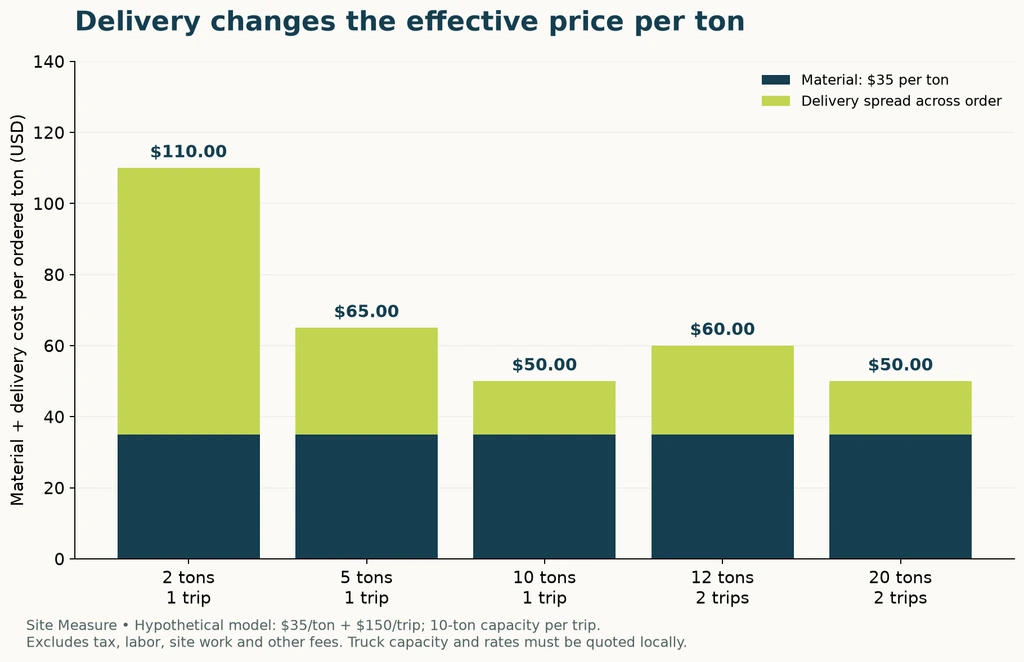
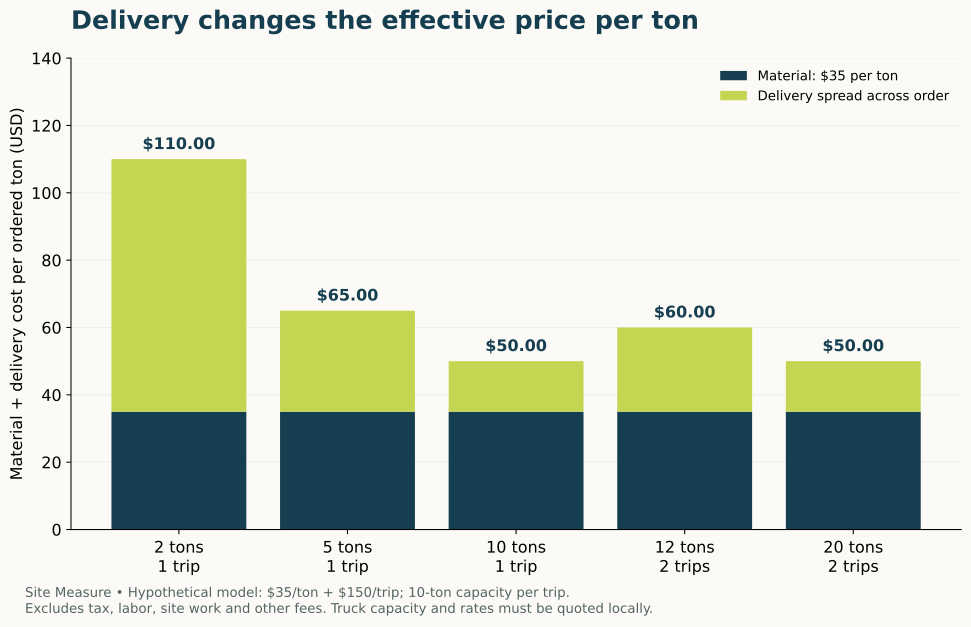
A flat delivery charge is spread over the tons ordered. But if another truck trip is needed, the effective price can rise again. The chart uses an illustrative $35/ton material rate, $150 per trip and 10-ton capacity. Actual truck limits depend on the supplier, vehicle and access.
| Order | Trips | Subtotal | Per ton |
|---|---|---|---|
| 2 US tons | 1 | $220.00 | $110.00 |
| 5 US tons | 1 | $325.00 | $65.00 |
| 10 US tons | 1 | $500.00 | $50.00 |
| 12 US tons | 2 | $720.00 | $60.00 |
| 20 US tons | 2 | $1,000.00 | $50.00 |
Real schedules can use other models. Grondin lists Zone 1 delivery of $100 for 1–3 cubic yards and a separate 7-plus-yard bracket of $10/yard or $9/ton. Its published brackets do not state a rate for 4–6 yards; ask for a quote rather than interpolating. Source [1].
Main’s says delivery is charged each time a truck leaves its yard and recommends allowing for multiple deliveries when products, quantities or access require them. Source [2], printed page 4. Do not buy unnecessary gravel merely to lower the average delivery cost.
Compare driveway quotes on the same scope
Ask each supplier or contractor to price the same quantities and clearly identify what is included. A low aggregate price and a complete installed-driveway quote are not comparable totals.
| Line item | What to confirm |
|---|---|
| Material | Exact product, selling unit, bulk density, layer quantities and order rounding. |
| Delivery | Total trips, fee basis, distance zone, fuel charges, minimum order and unloading location. |
| Preparation | Excavation, removal, disposal and grading included or excluded? |
| Installation | Spreading, compaction, equipment and labor included or excluded? |
| Site-specific work | Drainage, edging, geotextile or permits required for this site, and who prices them? |
| Final payment | Tax, payment fees, quote validity and changes to scope. |
For a refresh, confirm that the existing driveway is suitable for the proposed work before treating the job as a simple top-up. Quantity estimates alone cannot establish the condition of the base or drainage.
A practical planning timeline before delivery
Use these decision points in order. They are not promises about construction duration or a supplier’s lead time.
- Before requesting quotes: measure the site and identify whether the job is a top-up or new construction. Ask the installer to define layers and the measurement basis.
- When comparing quotes: record the product, unit, quantity, total delivery charge and included site work. Resolve missing line items.
- Before booking: confirm stock, access, unloading space, order increments and the quote’s expiry date.
- Before the installation day: coordinate the delivery window with the crew and equipment. Main’s advises having material delivered the day before it is needed; this is that supplier’s recommendation, not a universal rule. Source [2].
- On delivery: compare the delivery ticket’s material and billed quantity with your order, then retain it with the project estimate.
Gravel driveway cost questions
Can I use a price per square foot?
Yes, as a summary of a clearly specified scope. Divide the quoted total by the same measured area. Our worked subtotal is $370.50 ÷ 480 = $0.77/ft², but that number covers only material and the assumed delivery. It should not be presented as an installed-driveway rate.
Is pricing by the ton cheaper than pricing by the yard?
Neither unit is inherently cheaper. For the same product and conditions, convert a ton quote to a yard quote using its bulk density: dollars per yard = dollars per US ton × pounds per yard ÷ 2,000. Then add the delivery terms and fees. Read our gravel coverage guide for how density changes the quantity.
Does “2026” mean these prices are guaranteed today?
No. It identifies the year on the dated source documents. We checked those documents on September 17, 2026; suppliers can revise prices, availability and delivery terms. Get a current written quote for the actual job.
Sources, methodology and editorial responsibility
Sources last checked: . The last content update expanded the worked project with allowance, order rounding, depth comparisons and calculator instructions.
Site Measure prepared this guide as an independent calculation and document review. We checked the PDF table columns visually, kept retail and direct-ship entries separate, and tested the example arithmetic. We did not obtain custom quotes, conduct a national price survey or build the illustrated driveway.
- R.J. Grondin & Sons: 2026 loaded aggregate price list
Page 1; dated April 13, 2026. Check plant columns, product codes and delivery quantity brackets.
- Main’s Landscape Supply: Spring 2026 retail price list
Printed pages 3–5 for terms and delivery; page 11 for gravel. Those pages are dated April 1, 2026. Southfield, Michigan.
- NIST: unit conversion factors
Unit definitions, including a US short ton of 2,000 lb.
The original chart is generated from subtotal = tons × $35 + ceiling(tons ÷ 10) × $150. The CSV contains the quantities, trip counts, material and delivery subtotals. The fixed rates and truck capacity are assumptions, separate from the cited supplier prices.
You may reuse our original chart and calculation data with attribution to Site Measure and a link to this article. Third-party documents retain their owners’ terms. Figures are in US dollars; taxes and unlisted work are excluded from our examples.
Prepared with AI assistance for writing and illustration. Automated calculation checks do not constitute independent engineering or contractor review. About the maintainer · Calculation methodology · Report a correction.