THE SHORT ANSWER
Build a gravel patio or path as two layers: about 4 in of compacted road base, then 3 in of surface. Decomposed granite compacts into a firm surface; ¾ in crushed stone drains and holds better than rounded pea gravel, which fails the US Access Board’s firm-and-stable test as a loose surface. A 12 × 12 ft patio takes 2.5–2.7 t of base plus 1.6–1.8 t of surface; at the recorded list prices that is about $202–218 of stone before delivery.
A gravel patio or path is two layers: a compacted base that carries the load, and a surface you walk on. Which surface you choose decides how firm it feels underfoot, how it drains and how much it costs. The depths below come from a decomposed granite producer, a stabilizer maker, the paver industry’s base specification and the US Access Board’s trail guidance; the quantities and prices come from the weights and list prices in our ledgers.
Which gravel for a patio or path
The clearest published test for a walking surface is the US Access Board’s: a firm surface “resists deformation by indentations”, a stable one “is not permanently affected by expected weather conditions and can sustain normal wear and tear”. Its construction tips for a surface that passes are “crushed rock (rather than uncrushed gravel)”, “rocks with broken faces (rather than rounded rocks)”, “a rock mixture containing a full spectrum of sieve sizes, including fine material”, “rock that passes through a ½-inch screen” and “rock material that is compacted in 3- to 4-inch layers”. Measured against that list, the three gravels people lay on patios behave very differently.
| Surface | What it is | Underfoot | Published depth | Weight per yd³ (ledger) | List price per ton (median) |
|---|---|---|---|---|---|
| Pea gravel | Rounded ⅜ in stones, washed, no fines | Rolls and shifts: fails “broken faces” and “fine material”; loose gravel is what the Access Board’s research lists as a barrier | 2–3 in as inorganic mulch (Utah State); no producer we found specifies a walking depth | 2,440–2,720 lb | $56.98 (6 lists) |
| Decomposed granite (DG) | Granite grit, ¼ in down to fines, angular | Compacts into a firm crust: passes every tip; can be stabilized | 3 in compacted on 4–6 in of compacted road base (Kafka Granite); 3–4 in stabilized on 3 in base (Stabilizer Solutions) | 2,400–2,500 lb | $52.95 (2 lists) |
| ¾ in crushed stone | Angular, washed, no fines | Locks better than rounded stone but stays loose on top: broken faces, yes; fines and ½ in screen, no. Drains fastest | 2–3 in as mulch (Utah State); 4 in to suppress weeds (Colorado State) | 2,600–2,800 lb | $42.75 (5 lists) |
So the choice is a trade: DG gives the firmest surface and the smoothest walk, at the cost of compaction work and occasional top-ups; ¾ in crushed stone drains best and needs no compacting, but stays a loose layer; pea gravel is the softest to walk on and the one the accessibility test rules out. Pea gravel is also not the cheapest per ton in our price lists. Compare every type side by side under types of gravel.
How deep the base and the surface should be
Every published figure for a gravel walking surface puts it on a compacted base. Kafka Granite specifies a 3 in compacted surface of its pathway mix on 4–6 in of compacted road base for a “walking path or patio”, and 4 in on 8–12 in where vehicles drive; its wax-coated mix may go down at 2 in. Stabilizer Solutions’ installation sheet calls for 3 in (light traffic) or 4 in (heavy) of stabilized aggregate on 3 in of compacted DOT crushed road base. The paver industry’s Tech Spec 2 sets 4 in as the minimum compacted base under a pedestrian paver surface on well-drained soil, and the Access Board compacts tread material “in 3- to 4-inch layers”, “moist (but not too wet)”, with vibrating equipment.
| Source | Surface | Base |
|---|---|---|
| Kafka Granite, standard pathway mix | 3 in compacted (walking path or patio); 4 in where vehicles drive | 4–6 in compacted road base; 8–12 in for vehicles |
| Kafka Granite, wax-coated mix | 2 in minimum | As for a walking path |
| Stabilizer Solutions, pedestrian installation sheet | 3 in light traffic, 4 in heavy traffic | 3 in compacted DOT crushed road base |
| ICPI Tech Spec 2 (paver base) | — | 4 in minimum compacted base for pedestrian areas |
| US Access Board, Chapter 10 | Compact in 3–4 in layers; passes a ½ in screen | — |
| Utah State / Colorado State Extension (as mulch) | 2–3 in inorganic mulch; 4 in to suppress weeds | — |
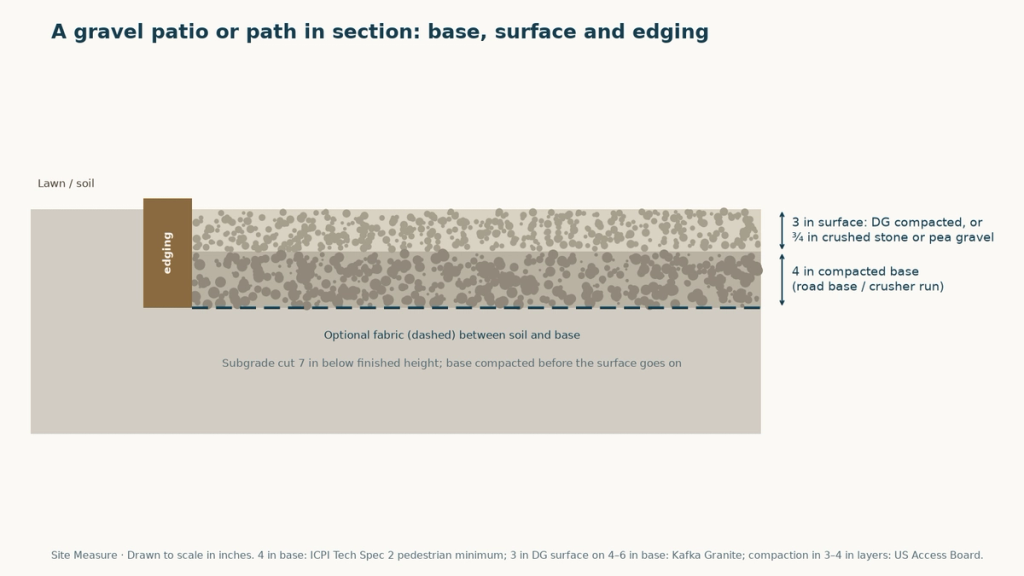
The figures below use 4 in of base and 3 in of surface, the thinnest combination those sources support for foot traffic. Dig 7 in below the finished height, set the edging, compact the base, then spread and compact the surface. The Forest Service builds the trail version the same way: geotextile first, “retainer rocks or logs” to hold the edge, then “high-quality tread material as fill above the geotextile”.
How much gravel a patio or path takes
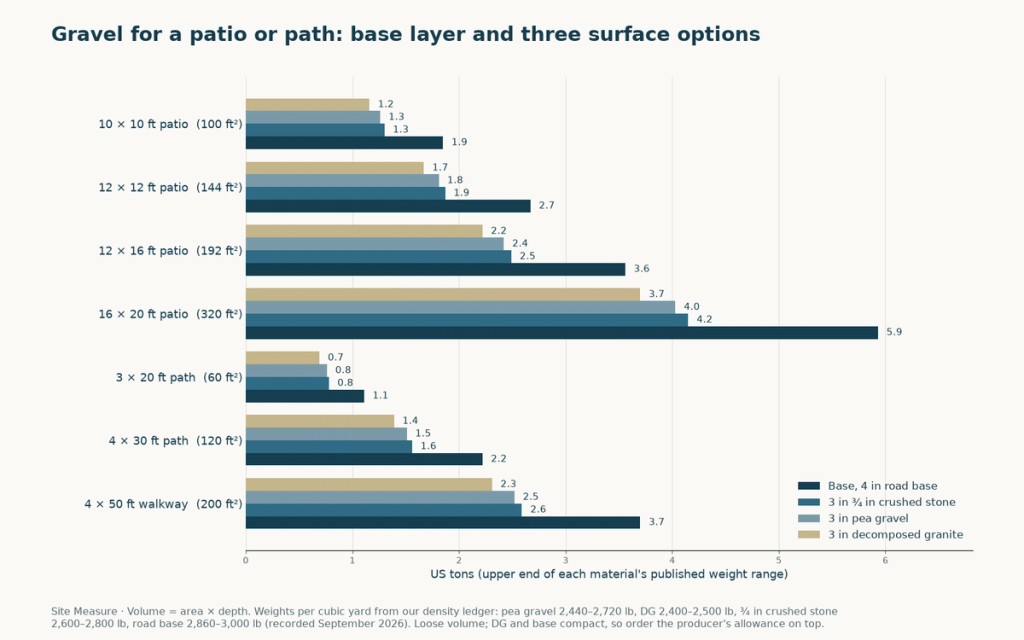
Volume is area × depth. Weights are the published supplier figures in our density ledger, recorded in September 2026: pea gravel 2,440–2,720 lb per cubic yard, DG 2,400–2,500 lb, ¾ in crushed stone 2,600–2,800 lb and road base 2,860–3,000 lb. Each cell gives tons at the lighter and heavier weight.
| Project (area) | Base, 4 in road base | Pea gravel, 3 in | DG, 3 in | ¾ in crushed stone, 3 in |
|---|---|---|---|---|
| 10 × 10 ft patio (100 ft²) | 1.23 yd³ · 1.8–1.9 t | 0.93 yd³ · 1.1–1.3 t | 0.93 yd³ · 1.1–1.2 t | 0.93 yd³ · 1.2–1.3 t |
| 12 × 12 ft patio (144 ft²) | 1.78 yd³ · 2.5–2.7 t | 1.33 yd³ · 1.6–1.8 t | 1.33 yd³ · 1.6–1.7 t | 1.33 yd³ · 1.7–1.9 t |
| 12 × 16 ft patio (192 ft²) | 2.37 yd³ · 3.4–3.6 t | 1.78 yd³ · 2.2–2.4 t | 1.78 yd³ · 2.1–2.2 t | 1.78 yd³ · 2.3–2.5 t |
| 16 × 20 ft patio (320 ft²) | 3.95 yd³ · 5.7–5.9 t | 2.96 yd³ · 3.6–4.0 t | 2.96 yd³ · 3.6–3.7 t | 2.96 yd³ · 3.9–4.2 t |
| 3 × 20 ft path (60 ft²) | 0.74 yd³ · 1.1–1.1 t | 0.56 yd³ · 0.7–0.8 t | 0.56 yd³ · 0.7–0.7 t | 0.56 yd³ · 0.7–0.8 t |
| 4 × 30 ft path (120 ft²) | 1.48 yd³ · 2.1–2.2 t | 1.11 yd³ · 1.4–1.5 t | 1.11 yd³ · 1.3–1.4 t | 1.11 yd³ · 1.4–1.6 t |
| 4 × 50 ft walkway (200 ft²) | 2.47 yd³ · 3.5–3.7 t | 1.85 yd³ · 2.3–2.5 t | 1.85 yd³ · 2.2–2.3 t | 1.85 yd³ · 2.4–2.6 t |
DG and road base lose volume when compacted; Kafka’s depths are measured after compaction, so order the loose volume your producer specifies for a given compacted depth (the decomposed granite calculator and the road base calculator carry those allowances). Bags make sense only for the smallest jobs: 3 in of pea gravel on a 3 × 20 ft path is 15 ft³, or 30 half-cubic-foot bags. For any other size, use the pea gravel calculator or the crushed stone calculator with your own dimensions.
What the stone costs
These are the per-ton medians of the list prices in our ledger (recorded September 2026): road base $43 across 8 lists, ¾ in crushed stone $42.75 (5), DG $52.95 (2) and pea gravel $56.98 (6). By the yard, pea gravel lists at $85.49 median and DG at $120.00. Delivery is extra on every list.
| Project | Base alone | Base + pea gravel | Base + DG | Base + ¾ in crushed stone |
|---|---|---|---|---|
| 10 × 10 ft patio | $76–80 | $140–152 | $135–141 | $127–135 |
| 12 × 12 ft patio | $109–115 | $202–218 | $194–203 | $183–195 |
| 12 × 16 ft patio | $146–153 | $270–291 | $259–271 | $245–259 |
| 16 × 20 ft patio | $243–255 | $449–485 | $431–451 | $408–432 |
| 3 × 20 ft path | $46–48 | $85–91 | $81–85 | $77–81 |
| 4 × 30 ft path | $91–96 | $168–182 | $162–170 | $153–162 |
| 4 × 50 ft walkway | $152–159 | $281–302 | $270–282 | $255–270 |
Two things move the real bill more than the material choice. Delivery: a patio’s worth of stone is a small load, and small loads pay the most per ton (see the dump truck load guide). And the base: it is heavier than the surface and, at these depths, costs more than the surface does, so skipping it is where a cheap patio becomes a soft one.
Edging, fabric and compaction
Edging holds the base and surface at their depth; without it the surface migrates into the lawn. Fabric between soil and base keeps the two from mixing; the extension services disagree about fabric under rock mulch (Colorado State says it is not needed at the right depth and woven fabric “eventually becomes clogged”; Utah State allows a fabric that passes air and water, never plastic), but under a trafficked base the trail guidance is to lay geotextile first. Compaction is what turns DG or road base from a pile into a surface: moist material, 3–4 in layers, a vibrating plate.
How these figures were worked out
- Stone (ft³) = length × width × depth ÷ 12; yd³ = ft³ ÷ 27; bags = ft³ ÷ 0.5, rounded up.
- Tons = yd³ × the lighter and heavier published weight ÷ 2,000; cost = tons × the per-ton median list price. No compaction or waste allowance; delivery excluded.
- Depths: 4 in base (ICPI pedestrian minimum; within Kafka’s 4–6 in) and 3 in surface (Kafka and Stabilizer Solutions).
Questions
Is pea gravel good for a patio?
It is the softest surface to walk on and the one that fails the Access Board’s firm-and-stable test: rounded stones with no fines roll instead of locking, and its research lists loose gravel among the barriers to access. It drains well and looks tidy; if you want it, keep it 2–3 in deep on a compacted base inside firm edging, and expect to rake it back.
Do I need a base under a gravel patio?
Every producer figure we found puts the surface on one: Kafka Granite specifies 4–6 in of compacted road base under 3 in of pathway mix, Stabilizer Solutions 3 in of compacted DOT crushed base, and the paver industry 4 in under a pedestrian surface. The base carries the load and keeps the surface from sinking into soil.
How many bags of pea gravel for a 10 × 10 ft patio?
25 ft³ at 3 in deep, which is 50 half-cubic-foot bags; at 2 in it is 16.7 ft³ or 34 bags. The same area in bulk is 0.9 cubic yards, about 1.1–1.3 t.
Sources
- US Access Board: Chapter 10, Outdoor Developed Areas (ABA guide)
Firm and stable definitions; crushed rock, broken faces, fines, ½ in screen, 3–4 in compacted layers.
- Kafka Granite: Standard Pathway Mix
3 in compacted surface on 4–6 in compacted road base for paths and patios; 4 in on 8–12 in for vehicles.
- Kafka Granite: How much aggregate you should order for your pathway
2 in minimum for the wax-coated mix.
- Stabilizer Solutions: pedestrian installation sheet
3 in (light) or 4 in (heavy traffic) on 3 in compacted DOT crushed road base.
- Interlocking Concrete Pavement Institute: Tech Spec 2: Construction of Interlocking Concrete Pavements (revised February 2020; dealer-hosted copy)
4 in minimum compacted base under pedestrian pavers on well-drained soil.
- Utah State University Extension: Water-Wise Landscaping, Mulch (2007)
2–3 in of inorganic mulch; fabric that passes air and water.
- Colorado State University Extension: Mulching, GardenNotes (reviewed April 2023)
4 in for any mulch meant to suppress weeds; woven fabric clogs.
- US Forest Service: Trail Construction and Maintenance Notebook (0723-2806-MTDC, 2007), Trails in Wet Areas
Geotextile under the fill, retainer rocks or logs, high-quality tread material above.
- Lasalle Sand & Gravel: Pea gravel
2,700 lb per cubic yard; recorded 2026-09-16.
- South Bay Materials: 3/8 inch pea gravel
2,440 lb per cubic yard; recorded 2026-09-16.
- Anchorage Sand & Gravel: 3/8 inch Minus Concrete Pea Gravel
2,600 lb per cubic yard; recorded 2026-09-18.
- Sutherland Landscape Supplies: Pea Gravel (3/8 inch minus)
2,540 lb per cubic yard; recorded 2026-09-18.
- Smokey Point Concrete: 3/8 Pea Gravel (#8)
2,720 lb per cubic yard; recorded 2026-09-18.
- Granite Landscape Centers: Desert Pearl 3/4 inch decorative rock
2,600 lb per cubic yard; recorded 2026-09-23.
- Outdoor Warehouse Supply: Decomposed Granite, 1/4 inch minus
2,500 lb per cubic yard; recorded 2026-09-23.
- Sutherland Landscape Supplies: Decomposed Granite North
2,400 lb per cubic yard; recorded 2026-09-23.
- LandCare Stone: 3/4 inch Crushed Stone
2,800 lb per cubic yard; recorded 2026-09-23.
- Birch Tree Bark & Stone: 3/4 inch Crushed Limestone
2,600 lb per cubic yard; recorded 2026-09-23.
- Sutherland Landscape Supplies: Road Base
2,860 lb per cubic yard; recorded 2026-09-23.
- Lyngso Garden Materials: Virgin Class 2 Base Rock
3,000 lb per cubic yard; recorded 2026-09-23.
- Rock N Yard: Recycled Road Base, 1.5 inch minus
2,600 lb per cubic yard; recorded 2026-09-23.
- Washington State DOT: Crushed Surfacing Base Course, truck measure
2,950 lb per cubic yard; recorded 2026-09-23.
- Harken's Landscape Supply: price list
List prices, East Windsor, CT; recorded 2026-09-23.
- Main's Landscape Supply: price list
List prices, Southfield, MI; recorded 2026-09-23.
- Bracht Bros: price list
List prices, Forest Lake, MN; recorded 2026-09-23.
- Piedmont Landscape Materials: price list
List prices, Concord, NC; recorded 2026-09-23.
- Down To Earth Materials: price list
List prices, Gray, TN; recorded 2026-09-23.
- Texas Garden Materials: price list
List prices, Houston, TX; recorded 2026-09-23.
- Outdoor Warehouse Supply: price list
List prices, Lewisville, TX; recorded 2026-09-23.
- Bedrock Landscaping Materials: price list
List prices, Denver, CO; recorded 2026-09-23.
- Ainsworth Rock Sales: price list
List prices, Denver, CO; recorded 2026-09-23.
- AZ Rock Express: price list
List prices, Apache Junction, AZ; recorded 2026-09-23.
- MRM Landscape Supply: price list
List prices, Ellensburg, WA; recorded 2026-09-23.
- Sequoia Landscape Materials: price list
List prices, Santa Rosa, CA; recorded 2026-09-24.
- Outdoor Warehouse Supply: price list
List prices, Lewisville, TX; recorded 2026-09-24.
- Sutherland Landscape Supplies: price list
List prices, Chico, CA; recorded 2026-09-24.
- R.J. Grondin & Sons: price list
List prices, Gorham, ME; recorded 2026-09-23.
- Young's Sand & Gravel: price list
List prices, Loudonville, OH; recorded 2026-09-23.
- BOSS Boone One Stop Supply: price list
List prices, Wake Forest, NC; recorded 2026-09-23.
- Mulch Pros Landscape Supply: price list
List prices, Cumming, GA; recorded 2026-09-23.
The sources for this guide are listed above; prices and specifications change, so confirm them with your supplier before you order. How we source and calculate · Report an error