THE SHORT ANSWER
The stone gets dearer every year; in 2026 the trucking did too.
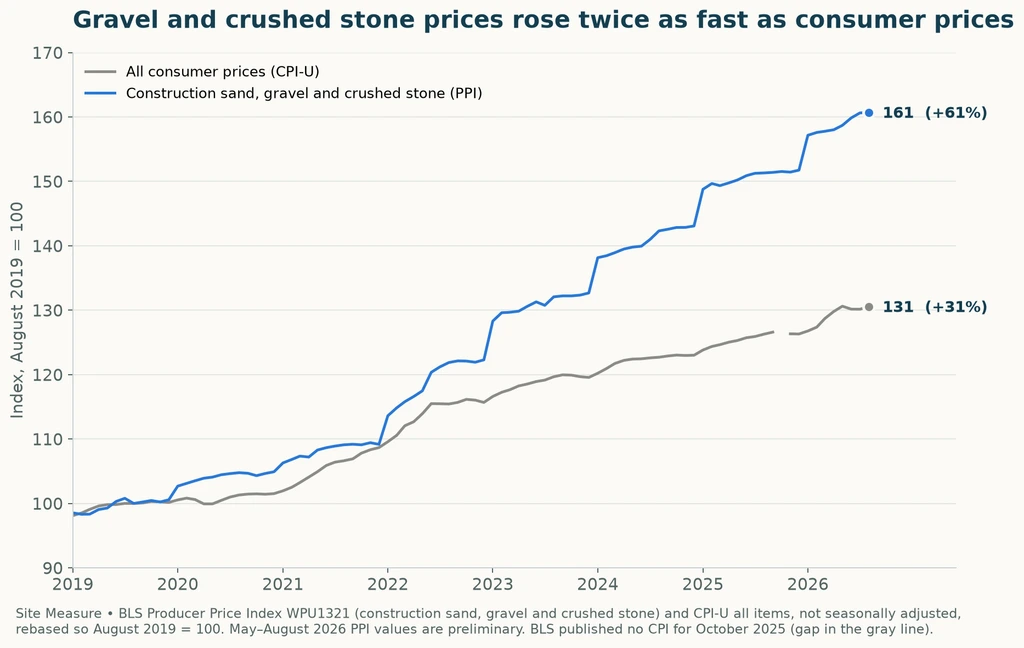
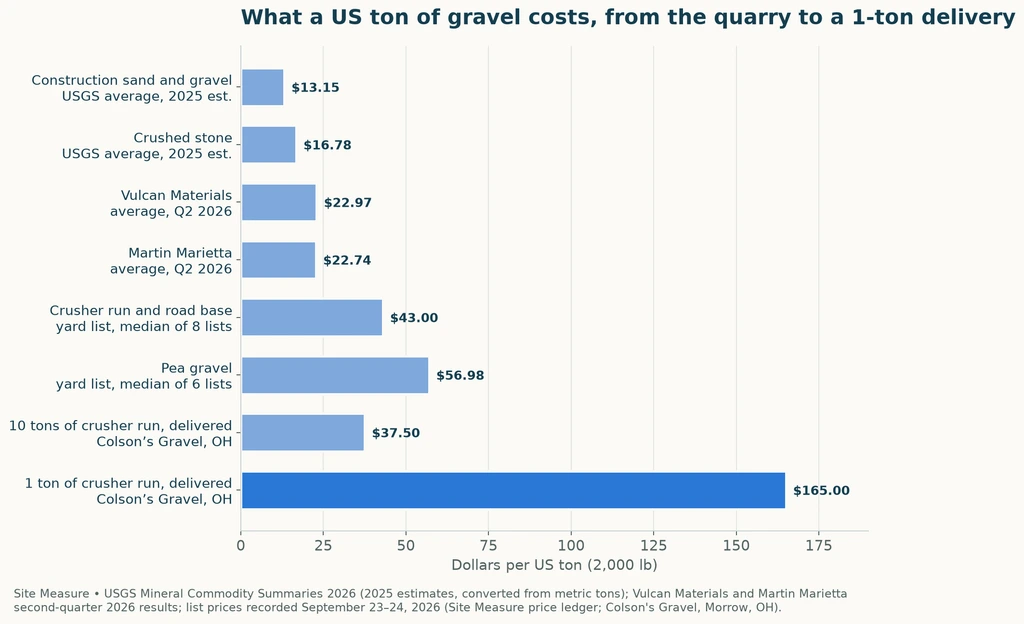
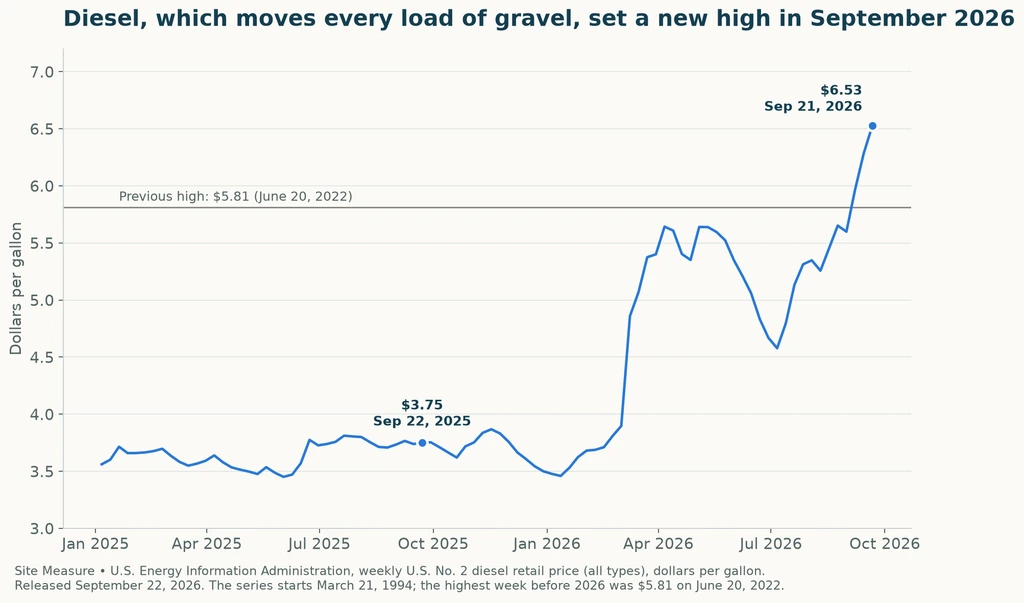
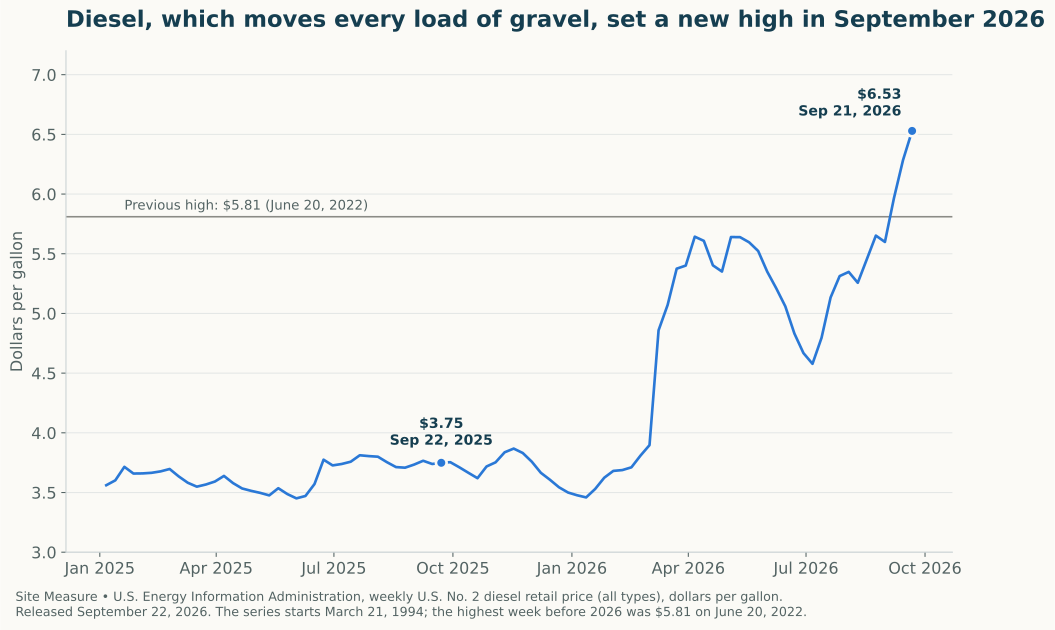
Producer prices for construction sand, gravel and crushed stone were +6.2% in August 2026 against a year earlier and +61% since August 2019, twice the +31% rise in consumer prices (BLS). Diesel, which moves every load, reached $6.53 a gallon on September 21, 2026, +74% in a year and the highest week in EIA’s series. And most of what a homeowner pays is not the stone: quarries averaged about $16.78 a ton in 2025, while one Ohio yard charges $165.00 to deliver a single ton.
None of this changes how much gravel a job needs, only what each ton costs to get there. Work out the tons first with the gravel calculator, then use the figures below to judge a quote.
Gravel prices have risen twice as fast as consumer prices since 2019
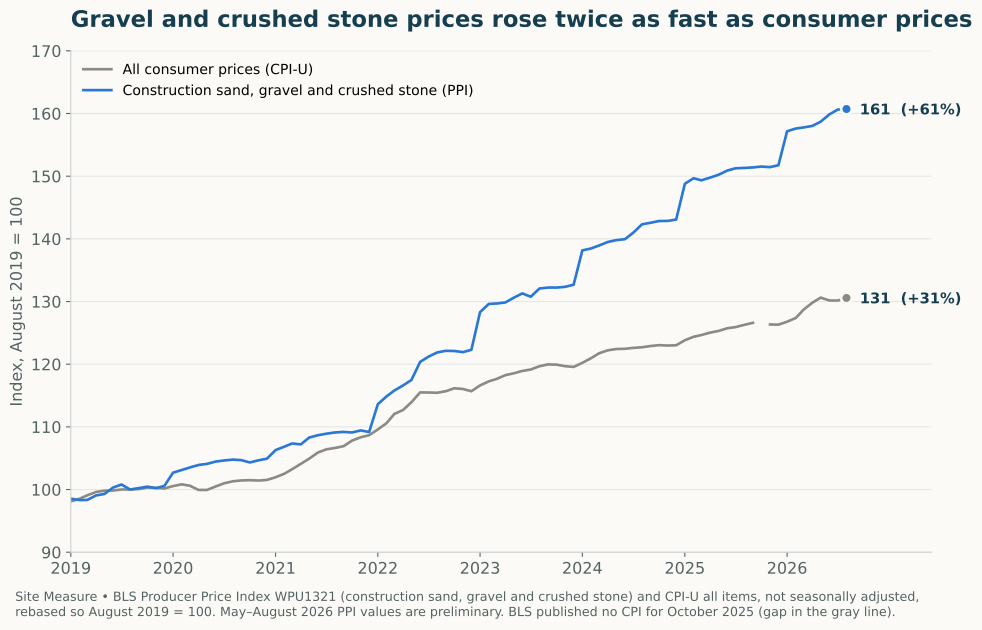
The Bureau of Labor Statistics tracks what producers charge for construction sand, gravel and crushed stone in its Producer Price Index (series WPU1321). Rebased to August 2019, the index stood at 161 in August 2026; the consumer price index stood at 131. Producer prices rose faster than consumer prices in 6 of the last 7 twelve-month periods; the exception was the year to August 2021.
| Year to August | Sand, gravel and crushed stone (PPI) | All consumer prices (CPI-U) |
|---|---|---|
| 2020 | +4.8% | +1.3% |
| 2021 | +4.1% | +5.3% |
| 2022 | +11.7% | +8.3% |
| 2023 | +8.4% | +3.7% |
| 2024 | +7.8% | +2.5% |
| 2025 | +6.3% | +2.9% |
| 2026 | +6.2% | +3.4% |
In all 80 months since January 2020, the index was higher than a year before. The smallest twelve-month rise was +3.2% (April 2021) and the largest +12.9% (January 2023).
What a ton of gravel costs at the quarry
The U.S. Geological Survey puts the average value of crushed stone at $16.78 per US ton in 2025 and of construction sand and gravel at $13.15: prices at the pit or quarry, before any trucking. That is +40% and +38% on 2021.
| Year | Crushed stone | Construction sand and gravel |
|---|---|---|
| 2021 | $12.03 | $9.54 |
| 2022 | $12.98 | $10.30 |
| 2023 | $14.39 | $11.38 |
| 2024 (est.) | $15.88 | $12.61 |
| 2025 (est.) | $16.78 | $13.15 |
The two largest producers report similar figures for 2026. Vulcan Materials sold aggregates at $22.97 a ton in the second quarter, against $22.11 a year earlier, and put the mix-adjusted rise at 5%. Martin Marietta averaged $22.74, below last year’s $23.21 mainly because of the mix of businesses it acquired; on an organic mix-adjusted basis its prices rose 3.7%.
Vulcan’s filing also shows fuel reaching the quarry itself: its cash cost per ton rose 7%, but only 3% once higher diesel costs are taken out. Its chief executive said unit profit grew “despite significant energy inflation and disruptive weather.”
Why you pay far more than the quarry price
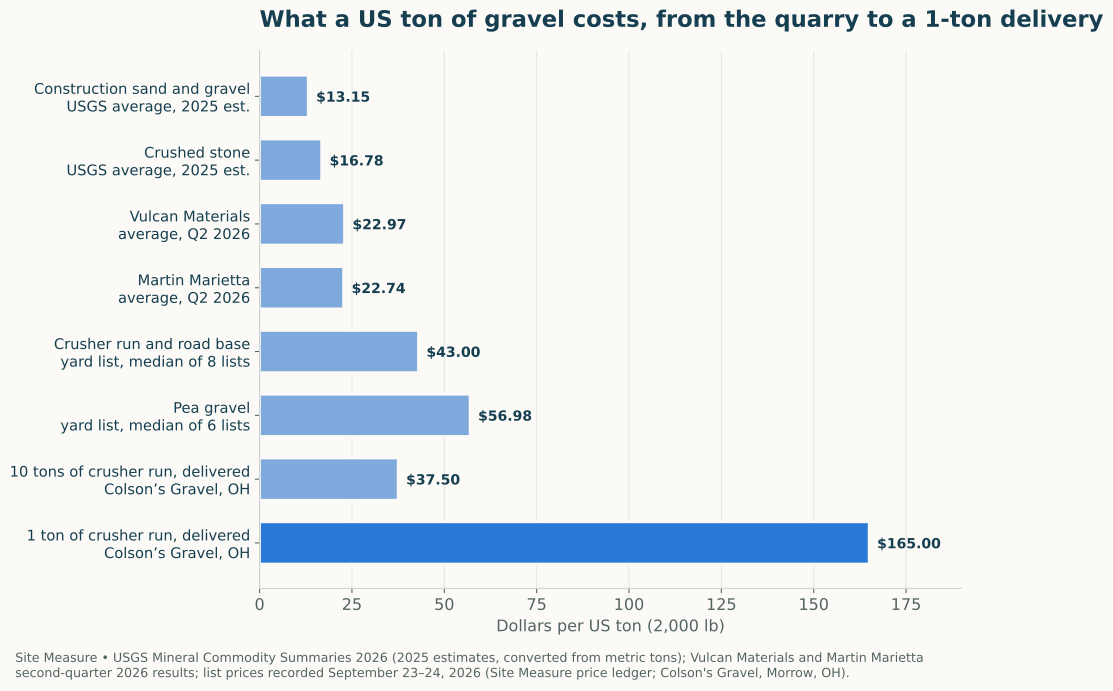
A national average at the quarry is not a price anyone can buy a single ton at. The chart sets it against the list prices we record from landscape suppliers and against one Ohio yard’s delivered prices. A one-ton delivery costs about 10 times the average quarry value per ton. The gap is handling, the yard’s margin and, above all, the cost of a truck trip carried by a single ton.
| Step | Per ton | × quarry average |
|---|---|---|
| Construction sand and gravel USGS average value at the pit, 2025 estimate | $13.15 | 0.8× |
| Crushed stone USGS average value at the quarry, 2025 estimate | $16.78 | 1.0× |
| Vulcan Materials Freight-adjusted sales price per ton, second quarter 2026 | $22.97 | 1.4× |
| Martin Marietta Average selling price per ton, second quarter 2026 | $22.74 | 1.4× |
| Crusher run and road base Landscape-yard list price, median of 8 lists, before delivery | $43.00 | 2.6× |
| Pea gravel Landscape-yard list price, median of 6 lists, before delivery | $56.98 | 3.4× |
| 10 tons of crusher run, delivered Colson’s Gravel, Morrow, OH, within 20 miles | $37.50 | 2.2× |
| 1 ton of crusher run, delivered Colson’s Gravel, Morrow, OH, within 20 miles | $165.00 | 9.8× |
A full load from the Ohio yard, $37.50 a ton delivered, is cheaper than the $43.00 median list price before delivery. Prices differ more from town to town than between collecting a ton and having a full load delivered; the section on why towns differ shows how wide.
Record diesel prices and your delivery charge
EIA’s weekly U.S. diesel price was $3.46 in the week of January 12, 2026, jumped from $3.90 to $4.86 in the week to March 9, 2026, and reached $6.53 on September 21, 2026. That is above the previous high of $5.81 (June 20, 2022) in a series that began in 1994. So far in 2026 it has averaged $4.97, against $3.66 in 2025.
How much of that reaches your bill depends on the truck and the trip, and we found no published figure for gravel deliveries. The closest benchmark is ATRI’s 2025 trucking costs: fuel was $0.48 of the $2.34 it cost to run a truck a mile, about 21%. Scale only that fuel line from $3.66 to $6.53 diesel and the same mile costs $2.71, +16%. That is long-haul data and arithmetic, not a dump truck’s rate; it shows why a delivery charge can rise faster than the stone.
Diesel can also fall. It dropped 19% between April 6, 2026 and July 6, 2026. When you compare quotes, ask whether delivery is a fixed charge or carries a fuel surcharge, and how long the quoted price holds.
When producer prices rise: January
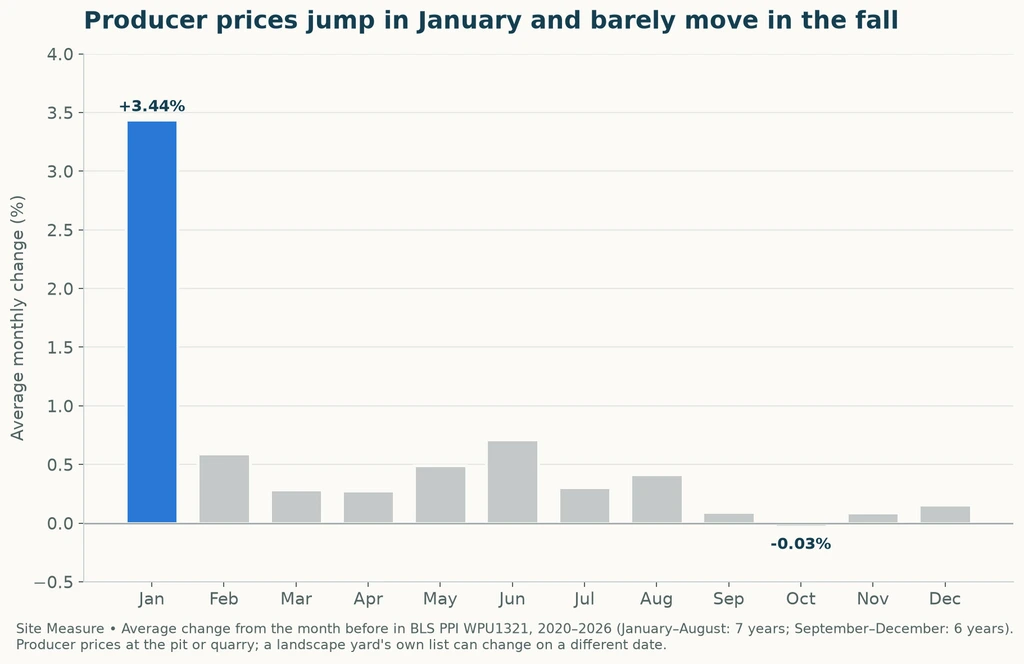
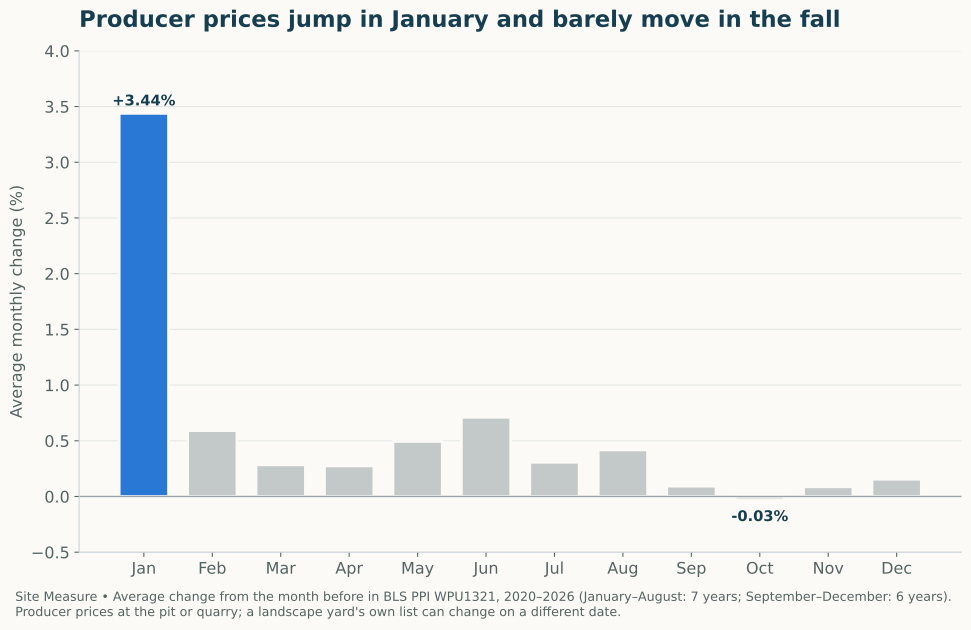
Averaged over 2020–2026, the producer index rose +3.44% from December to January, and no other month averaged more than +0.71%. From September to December it barely moved (+0.09%, −0.03%, +0.09%, +0.15%). January alone brought 58% of the whole-year rise in 2023, 53% in 2024 and 66% in 2025.
That is the price at the pit or quarry. A landscape yard reprices on its own date, so a job priced this fall is not certain to avoid a January rise; ask whether the quote holds past January 1.
Why the same stone costs more in some towns
Gravel is heavy for what it costs, so the distance it travels shows in the price. In its 2026 summaries the USGS expected shortages near cities to grow because of local zoning and competing land uses, pushing new quarries away from population centers, and said regional shortages and higher fuel costs “could result in higher-than-average price increases in industrialized and urban areas.”
The price lists we record show how wide the gap already is. Per ton, before delivery: crusher run and road base $15.00–$57.00 (8 lists), #57 and 3/4-inch clean stone $21.50–$69.00 (5 lists), pea gravel $39.99–$210.00 (6 lists). Every row, with its supplier and date, is on the gravel prices page.
How to keep a 2026 gravel order down
You cannot change the index or the diesel price. You can change how many trips a truck makes and what goes on it.
- Order the whole job in one delivery. On Colson’s Gravel’s list, two 5-ton deliveries cost $500.00; one 10-ton delivery costs $375.00.
- Get the quantity right before you call. A second small delivery repeats the trip. Measure with the gravel calculator; for a compacted base the gravel driveway calculator adds loose material for compaction.
- Stay inside one load. Twelve tons from the same yard is two trips: $550.00, or $45.83 a ton against $37.50 for ten. The dump truck load guide lists truck sizes and short-load fees.
- Choose the common local product. Median list prices per ton: crusher run and road base $43.00, river rock $70.00, decorative rock $73.98.
- Compare delivered totals. Ask each yard for material, delivery, fuel surcharge and tax on one line, for the same tons.
- Collect only what your vehicle can carry. Pickup payloads are smaller than most people expect; the guide to what 1 to 10 tons look like works it out for current half-ton trucks.
- Use bags only for small patches. Per cubic yard, bagged pea gravel costs several times bulk; the bags versus bulk guide finds the break-even.
Gravel price questions
Will gravel prices go down?
Not on the evidence so far. In all 80 months since January 2020, the BLS producer index for sand, gravel and crushed stone was higher than a year before; the smallest rise was +3.2%. Vulcan Materials wrote in July 2026 that the construction environment “remains supportive of continued aggregates price growth” (Q2 2026 results). Delivery is the part that can fall: diesel dropped 19% between April 6, 2026 and July 6, 2026.
Is gravel cheaper to buy in the fall?
At the producer level, prices are flattest from September to December, averaging +0.09%, −0.03%, +0.09%, +0.15% a month since 2020, against +3.44% in January. A landscape yard sets its own list date, so ask whether a fall quote still holds for a delivery after January 1.
How these numbers were worked out
- The BLS series came from the BLS public data API and the EIA diesel prices from EIA’s weekly table, both on September 26, 2026. BLS may still revise the producer index for May to August 2026.
- USGS values are national averages at the pit or quarry, printed per metric ton; we multiply by 0.90718474 (NIST) for US tons.
- Producer prices are as printed in each company’s second-quarter 2026 results filed with the SEC. They are averages across all products and markets, excluding delivery.
- Yard prices are published list prices recorded September 23–24, 2026 from 17 US suppliers; a median is shown only where three or more lists stand behind it. They are not a random sample of US yards.
- The delivered prices are one supplier’s published list, and the trucking arithmetic rescales one ATRI cost line. Neither is a national delivered price.
Sources
- U.S. Bureau of Labor Statistics: Producer Price Index, construction sand, gravel and crushed stone (WPU1321)
Monthly index, 1982 = 100, not seasonally adjusted. January 2019 to August 2026, retrieved from the BLS public data API. BLS marks May to August 2026 as preliminary and may revise them for four months.
- U.S. Bureau of Labor Statistics: Consumer Price Index for All Urban Consumers, all items (CUUR0000SA0)
Monthly index, 1982–84 = 100, not seasonally adjusted. BLS published no October 2025 value because of the 2025 lapse in appropriations.
- USGS Mineral Commodity Summaries 2026: Stone (Crushed)
Salient statistics: average unit value in dollars per metric ton, 2021–2025 (2024 and 2025 estimated); Events, Trends, and Issues on 2026 prices. February 2026.
- USGS Mineral Commodity Summaries 2026: Sand and Gravel (Construction)
Salient statistics: average unit value in dollars per metric ton, 2021–2025 (2024 and 2025 estimated). February 2026.
- Vulcan Materials: second quarter 2026 results (SEC Form 8-K, Exhibit 99.1)
July 29, 2026. Aggregates freight-adjusted sales price per ton and unit cash cost, with and without diesel.
- Martin Marietta: second-quarter 2026 results (SEC Form 8-K, Exhibit 99.1)
July 30, 2026. Aggregates average selling price per ton, reported and organic mix-adjusted.
- U.S. Energy Information Administration: weekly U.S. No. 2 diesel retail prices
Dollars per gallon, all types, on-highway, weekly since March 21, 1994. Data released September 22, 2026.
- American Transportation Research Institute: 2026 Analysis of the Operational Costs of Trucking (announcement)
July 2026. Average cost per mile to operate a truck in 2025, with and without fuel. Long-haul fleet data, not dump trucks.
- NIST: unit conversion factors
A US short ton is 907.18474 kg; a metric ton is 1,000 kg.
- Colson’s Gravel: products and prices
Morrow, OH. Delivered prices for 1 to 10 tons within 20 miles; recorded September 24, 2026.
You may reuse our charts and CSV. Please credit Site Measure. A link is appreciated, and nofollow is fine. The series remain their publishers’; check them for revisions.
Cite this page: Site Measure. “Why Is Gravel So Expensive? What 2026 Price Data Shows.” Updated September 26, 2026. https://site-measure.com/blog/why-is-gravel-so-expensive
Written with AI assistance from the sources listed on this page. Each figure links to its source; recorded dates are shown with the figures or in the gravel weight and price ledgers, and the arithmetic is covered by automated tests. How this page was made · Report an error