
THE SHORT ANSWER
One US ton covers about 114 sq ft at 2 inches deep.
At a bulk density of 105 lb/ft³, one US short ton (2,000 lb) of gravel covers 114.3 sq ft at 2 inches, 76.2 sq ft at 3 inches, or 57.1 sq ft at 4 inches. These are geometric estimates before compaction, settlement or extra allowance. Replace the density with your supplier’s value for a product-specific answer.
The 105 lb/ft³ value is the starting assumption in our gravel calculator, not a specification for every gravel product. A US short ton is 2,000 pounds; the weight definition comes from NIST’s conversion tables [1].
Gravel coverage chart: square feet per ton by depth
Every row below uses 105 lb/ft³. The depth means the thickness of the gravel layer being estimated, not the total excavation. The 1-, 3- and 5-ton columns use the same material and assumptions.
| Depth | 1 ton | 3 tons | 5 tons | 1 cubic yard |
|---|---|---|---|---|
| 1 in | 228.6 | 685.7 | 1142.9 | 324.0 |
| 2 in | 114.3 | 342.9 | 571.4 | 162.0 |
| 3 in | 76.2 | 228.6 | 381.0 | 108.0 |
| 4 in | 57.1 | 171.4 | 285.7 | 81.0 |
| 6 in | 38.1 | 114.3 | 190.5 | 54.0 |
| 8 in | 28.6 | 85.7 | 142.9 | 40.5 |
Site Measure calculations, rounded to one decimal place. No extra material or compaction factor. Depths are comparison scenarios, not installation recommendations.
A cubic yard and a ton are not interchangeable. A cubic yard is 27 cubic feet, so it covers 108 sq ft at 3 inches deep regardless of density, for that stated volume. A ton measures weight, so its volume—and coverage—depends on density.
How to calculate gravel coverage per ton
Divide the weight by bulk density to obtain volume. Then divide volume by layer depth, expressed in feet, to obtain area.
The 24,000 is 2,000 pounds per US ton multiplied by 12 inches per foot. For one ton at 3 inches and 105 lb/ft³:
- Volume: 2,000 ÷ 105 = 19.0476 ft³.
- Depth: 3 ÷ 12 = 0.25 ft.
- Coverage: 19.0476 ÷ 0.25 = 76.19 ft².
Use bulk density, which includes the spaces between particles. The density of solid rock alone does not describe a loose pile of gravel.
Why do gravel coverage estimates differ?
Changing depth or density changes the answer even when the order still weighs one ton. UC Master Gardeners gives a broad garden-path rule of thumb of 80–120 sq ft per ton at 2 inches deep. That is approximate guidance, not a fixed conversion for every product. Source [2].

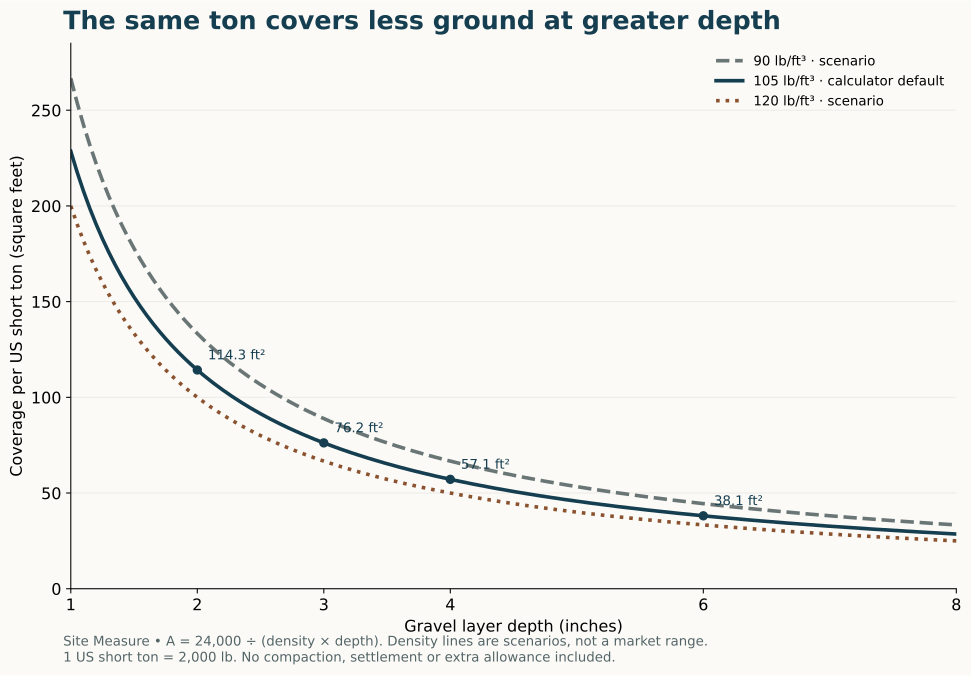
At the same density, increasing depth from 2 to 3 inches reduces coverage by one-third. At the same depth, a material that is 25% denser covers 20% less area per ton. These are consequences of the formula, not measured field results.
Depth errors matter too: spreading the default one-ton estimate at 3.5 inches instead of 3 inches reduces coverage from 76.2 to 65.3 sq ft—about 14.3% less area. Measure depth at several points rather than assuming the surface is level.
How much does a ton of pea gravel cover?
Use the weight of the actual product, even when both products are called pea gravel. Two published supplier references illustrate why a generic material name is not enough.
| Product reference | Published lb/yd³ | Derived lb/ft³ | 1 US ton at 3 in |
|---|---|---|---|
| Lasalle pea gravel [3] | 2,700 | 100.00 | 80.0 ft² |
| South Bay 3/8-inch pea gravel [4] | 2,440 | 90.37 | 88.5 ft² |
Convert pounds per cubic yard to pounds per cubic foot by dividing by 27. The lower published weight gives about 10.7% more calculated coverage per ton at the same depth. This is a comparison of two product listings, not a controlled test, an industry average or a recommendation to buy either product. Confirm the current weight basis and product specification with your supplier.
Worked example: will one ton cover a 10 × 8 ft area?
The area is 80 sq ft. At 3 inches deep, it needs 20 ft³. Using 105 lb/ft³ gives 2,100 lb, or 1.05 US tons, before any allowance. One ton falls slightly short under those assumptions.
At 100 lb/ft³, the same geometric volume weighs exactly 2,000 lb. That difference explains why two otherwise reasonable estimates can disagree: they are using different density assumptions.
If you choose a 10% extra allowance on the 1.05-ton estimate, the planning quantity becomes 1.155 tons. The 10% is an example of a user-selected allowance, not a universal recommendation or compaction correction. Supplier ordering increments may require further rounding.
Calculate your own dimensions
Enter length, width and depth, then adjust the material density and allowance. The calculator reports volume, weight, bags and quoted cost together.
Open the gravel calculator ↗US ton vs metric tonne: do not mix the tables
A US short ton is 2,000 lb (907.1847 kg). A metric tonne is 1,000 kg. At the same density and depth, one metric tonne therefore covers about 10.2% more area than one US short ton. Unit definitions: NIST [1].
For example, 1 tonne at an assumed 1,600 kg/m³ and 50 mm (0.05 m) deep covers 12.5 m² before allowances. This metric example uses its own illustrative density; it is not an exact conversion of the 105 lb/ft³ chart.
What to confirm before ordering gravel
- Weight unit: US short tons, metric tonnes, or another supplier unit.
- Product density: a bulk weight per cubic yard or cubic metre for the actual material.
- Layer basis: whether the quoted depth and density describe loose or compacted material.
- Job conditions: uneven areas, separate layers, handling losses and the installer’s required allowance.
- Purchase terms: minimum quantity, rounding increments and delivery charges.
A coverage table estimates quantity; it does not specify a driveway structure or guarantee installed thickness. For compacted work, ask the installer or supplier to translate the design depth into the loose quantity to order. Read our calculation methodology for assumptions and verification limits.
Sources, calculation method and reusable data
Sources checked September 16, 2026. This guide combines published unit definitions and supplier product weights with original arithmetic by Site Measure. We did not weigh or install these materials. The coverage table and chart are computed examples, not a field study.
- NIST: SI conversion factors
Unit definitions: US short ton, pound, foot and metric tonne.
- UC Master Gardeners: Gravel Pathways in the Garden
Garden-path coverage context; reissued March 2, 2020. Its approximate range is not the source of our density assumption.
- Lasalle Sand & Gravel: material weights
Pea gravel: 2,700 lb per cubic yard / 1.35 US tons per yard. Product-specific reference.
- South Bay Materials: 3/8-inch pea gravel
Published bulk material weight: 2,440 lb per cubic yard. Product-specific reference.
Download the chart data (CSV). Columns identify depth, bulk density, US short tons and square-foot coverage. Values are unrounded until export; the CSV retains four decimal places and the article displays one.
You may reuse the original calculation chart and data with attribution to Site Measure and a link to this guide. Suggested attribution: “Site Measure, How Much Does a Ton of Gravel Cover?, September 16, 2026; geometric calculations at stated densities.” Third-party source material remains subject to its owners’ terms.
Prepared with AI assistance for writing and illustration. Formulas are published above, and the calculation checks are automated; no independent engineering review is claimed. Report a correction.